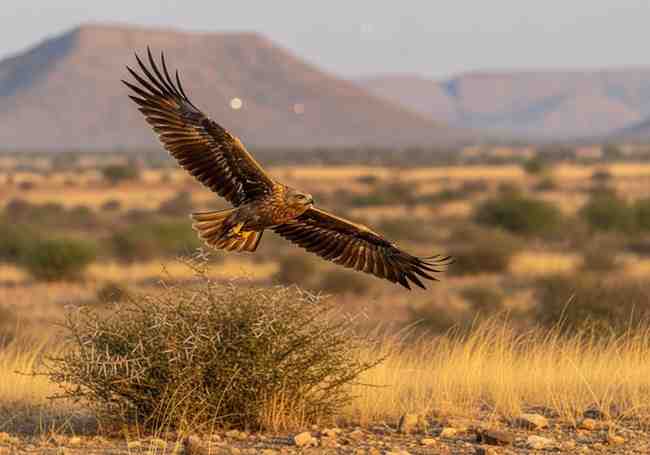
Rajasthan Emerges as a Key Winter Habitat for Steppe Eagle
The western part of Rajasthan has been recognised as an important wintering site for the Steppe Eagle, a migratory bird of prey facing global population decline. This highlights the ecological value of India’s desert landscapes in supporting migratory species during seasonal movements.
About the Steppe Eagle
The Steppe Eagle belongs to the Aquilinae subfamily, often referred to as booted eagles. It is a large raptor with dark brown feathers, a sturdy body, and a relatively small head. Its strong wings and gliding flight enable it to cover vast distances across open terrains such as grasslands and deserts.
Habitat and Distribution
This species is widely distributed across parts of Europe, Asia, and Africa. It breeds in Central Asian regions, including Kazakhstan, Russia, and Mongolia. During winter, it migrates southwards in search of food and suitable climate, with India serving as a major destination, particularly the arid zones of Rajasthan.
Behaviour and Ecological Features
The Steppe Eagle primarily feeds on small mammals like rodents, along with birds and reptiles. Unlike most eagle species, it prefers nesting on the ground, making it unique among raptors. Its migration is closely linked to seasonal variations and availability of prey in different regions.
Exam-Focused Points
-
Steppe Eagle: Migratory raptor wintering in Rajasthan
-
Scientific name: Aquila nipalensis
-
Subfamily: Aquilinae (booted eagles)
-
Breeding area: Central Asia
-
IUCN status: Endangered
Threats and Conservation Concerns
The species faces several threats, including habitat degradation, human disturbance, wildfires, and loss of nesting sites. Ground nesting increases vulnerability to predators and livestock movement. Recognising Rajasthan as a major wintering area underlines the need for focused conservation strategies.
Month: Current Affairs - March 29, 2026
Category: Environment, Biodiversity, Conservation