OVERVIEW
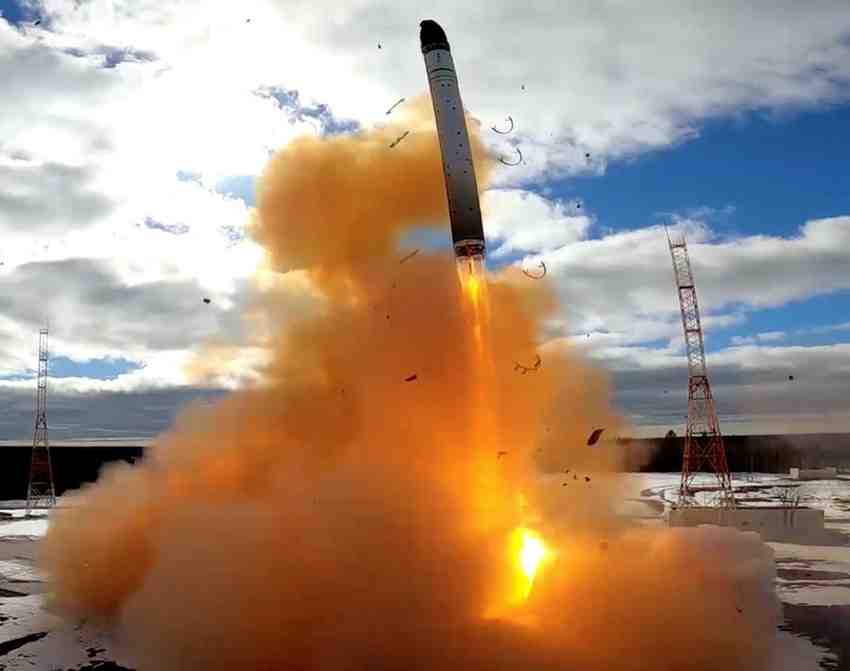
On 12 May 2026, Russia tested its Sarmat super-heavy intercontinental ballistic missile. The launch took place from the Plesetsk Cosmodrome in the Arkhangelsk region. The missile hit its target at the Kura test range on the Kamchatka Peninsula. The test is part of Russia’s plan to modernise its nuclear forces. The Sarmat is meant to replace the old Soviet-era R-36M2 Voyevoda missile. NATO calls it SS-29 Satan II. Russia wants to deploy the first Sarmat regiment by the end of 2026. However, the programme has faced delays and some failed tests in the past.
RUSSIA TESTS SARMAT MISSILE ON 12 MAY 2026
On 12 May 2026 , Russia conducted a test launch of the Sarmat missile. This is a super-heavy intercontinental ballistic missile (ICBM). The launch happened at the Plesetsk Cosmodrome in the Arkhangelsk region. The missile successfully hit its designated target at the Kura test range on the Kamchatka Peninsula. This test is part of Russia’s programme to modernise its nuclear forces.
WHAT IS THE SARMAT MISSILE SYSTEM?
The Sarmat is a liquid-fuelled intercontinental ballistic missile. It was developed for Russia’s strategic missile forces. NATO gives it the code name SS-29 Satan II . The Sarmat is designed to replace the old R-36M2 Voyevoda (NATO name: SS-18 Satan), which was built during the Soviet era.
Key features of the Sarmat:
-
Can carry multiple nuclear warheads
-
Designed to penetrate missile defence systems
-
Range is said to exceed 35,000 kilometres (very long range)
LAUNCH SITES AND DEPLOYMENT PLAN
Plesetsk Cosmodrome is a Russian military space launch facility in the Arkhangelsk region. It has been used for many missile and space launches over the years.
Kura test range is located on the Kamchatka Peninsula in Russia’s Far East. It serves as a target area for long-range missile tests.
Russia plans to deploy the first Sarmat missile regiment to combat duty by the end of 2026. This regiment will be based in the Uzhur formation of Krasnoyarsk Krai , which is associated with Russia’s Strategic Missile Forces.
TEST HISTORY AND TECHNICAL CHALLENGES
The Sarmat programme has not been smooth. It has faced delays and some reported test failures.
Despite these problems, the 12 May 2026 test appears to have been successful. Russia continues to push ahead with the programme.
RUSSIA’S STRATEGIC NUCLEAR FORCES
Russia’s nuclear forces are part of its strategic deterrent. They include three types of systems:
Month: Current Affairs - May 13, 2026
Category: SarmatMissile-SS29SatanII