Overview
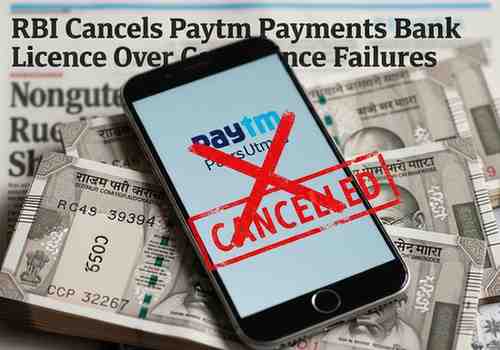
The Payments Bank of Paytm has been stripped of its licence by the Reserve Bank of India due to continued regulatory non-compliance and lapses in governance. A key move in the fintech and digital banking ecosystem in India is also the central bank taking steps to go to the High Court to seek winding-up proceedings.
Motives of RBI to do so.
The RBI said the activities of the bank were not in the best interests of depositors and there were concerns regarding the interest of the people. This strict action was caused by repeated failures to comply, low standards of governance and supervisory problems. The ruling is indicative of the zero-tolerance attitude of the regulator towards systemic risks in the financial industry.
Regulatory Action resulting in a cancellation.
The cancellation of the licence was preceded by a number of previous restrictions:
- In 2022, the bank was prohibited to accept new clients.
- In 2024, it was not allowed to take new deposits and credit operations.
- Other services like FASTag and NCMC operations were limited as well.
These actions denoted the increasing regulatory interference prior to the ultimate judgment.
Current Operational Status
After the cancellation, the bank is not able to continue with the normal banking activities. It is permitted just to make withdrawals of existing deposits. No credit, wallet top-ups or new deposits are allowed. The RBI has assured that the bank has adequate liquidity to pay off the depositors in the winding-up process.
Influence on the Fintech Ecosystem in India.
Paytm Payments Bank, established by Vijay Shekhar Sharma in 2017, has expanded quickly, with millions of users of its accounts, wallets, and digital payment offerings. With its size, compliance failures demonstrate the significance of regulatory discipline in fintech. The shift indicates a greater control and emphasizes on regulation of the ever-expanding digital financial systems.
Exam-Focused Points
- RBI revoked Paytm Payments Bank licence because of non-compliance.
- Bank not allowed to take new deposits; withdrawals only.
- Previous restrictions in 2022 and 2024.
- RBI to apply to High Court to wind-up.
- Underlines role of governance in fintech.
MCQ
Q. What is the main purpose of the Reserve Bank of India (RBI)?
A. Controlling stock markets.
B. Supervising and regulating the banking system.
C. Management of foreign trade.
D. Conduction of population census.
Answer: B
Definition: RBI is the central bank in India which regulates and oversees the financial and banking system to maintain stability and guard the interests of depositors.
Month: Current Affairs - April 25, 2026
Category: Economy, Banking