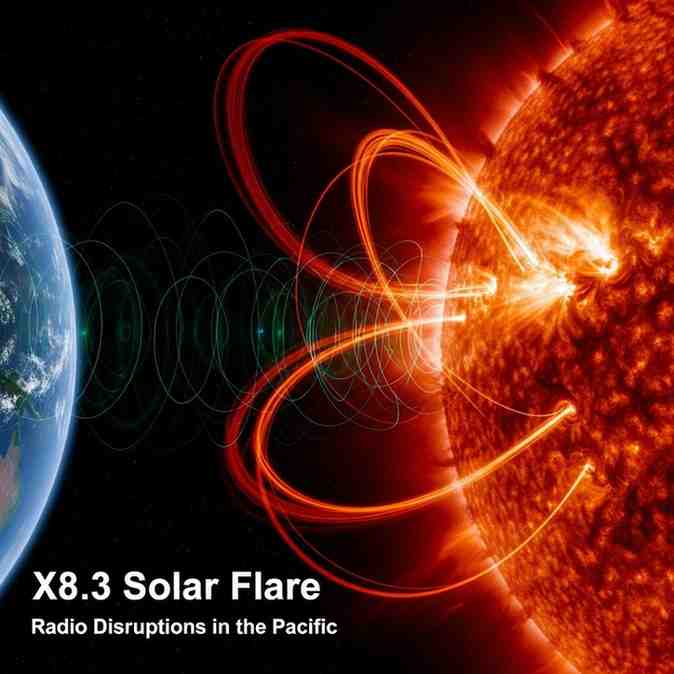
Sun Unleashes the Strongest Flare of the Year
The Sun has released its most powerful solar outburst of 2026 , prompting scientists worldwide to closely monitor space weather conditions. Over a span of 24 hours, multiple intense solar flares erupted, including a massive X8.3-class flare , the strongest recorded so far this year. The event briefly disrupted radio communications across parts of the Pacific region, underlining the growing volatility of the current solar cycle.
What Are Solar Flares?
Solar flares are sudden and intense bursts of electromagnetic energy released from the Sun’s surface due to rapid changes in its magnetic field. Scientists classify solar flares into five categories— A, B, C, M, and X —based on their peak X-ray output.
Each successive class represents a tenfold increase in energy . X-class flares are the most powerful and can affect satellites, navigation systems, and radio communications by disturbing Earth’s upper atmosphere.
Significance of the X8.3 Flare
The X8.3 flare ranks among the strongest solar explosions observed in recent years. It peaked at 6:57 pm EST on February 1 , releasing intense ultraviolet and X-ray radiation.
This radiation disrupted Earth’s ionosphere , triggering R3-level radio blackouts over parts of the South Pacific. Shortwave radio communications were temporarily affected in eastern Australia and New Zealand, illustrating how space weather can have immediate technological consequences on Earth.
Source of the Solar Eruptions
The powerful flares originated from a rapidly evolving sunspot cluster designated Region 4366 . Sunspots are cooler, magnetically active regions on the Sun that often serve as the source of major solar eruptions.
According to the NOAA Space Weather Prediction Center , Region 4366 has expanded quickly and exhibits unstable magnetic configurations. As the region rotates into a more Earth-facing position, scientists warn that the probability of additional strong flares remains high.
Potential Earth Impacts in the Coming Days
Researchers are currently analysing whether the flares were accompanied by coronal mass ejections (CMEs) —huge clouds of charged solar plasma that can trigger geomagnetic storms if directed toward Earth.
Preliminary assessments suggest that most solar material may miss the planet, though a minor geomagnetic impact around February 5 cannot be ruled out. If such an impact occurs, it could briefly elevate geomagnetic activity and enhance aurora displays at higher latitudes .
With Region 4366 remaining active, forecasters expect further solar eruptions in the near term.
Exam-Focused Key Points
-
X-class flares are the most powerful category of solar flares
-
Each flare class represents a tenfold increase in energy output
-
Solar flares primarily affect Earth’s ionosphere , not the lower atmosphere
-
Sunspots are magnetically active regions that trigger solar eruptions
-
Solar flares can
Month: Current Affairs - February 03, 2026
Category: Space Weather | Astrophysics