Overview
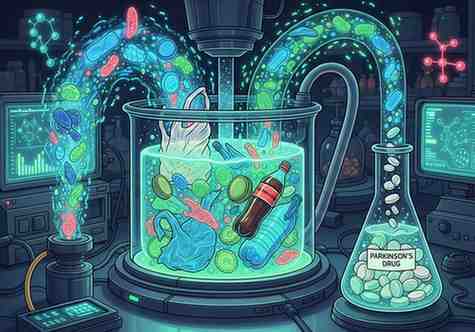
Under a significant scientific advancement, scientists at the University of Edinburgh have designed bacteria to turn plastic waste into levodopa, an important medication to treat Parkinson disease. The innovation shows how biotechnology can turn waste into medical products of high value, which is in line with sustainability and healthcare requirements.
Plastic to medicine, how it is done.
There was genetically modified Escherichia coli that was used to dismantle Polyethylene terephthalate, which is prevalent in bottles and packaging. The bacteria degrade the plastic carbon and use it to produce levodopa by synthesizing biochemical pathways which are engineered. This method is efficient in recycling plastic waste to form a feedstock of pharmaceuticals.
Importance for Parkinson’s Treatment
Levodopa is the most efficient therapy to be used in the treatment of the Parkinson disease because it assists in controlling the symptoms like tremors, rigidity and impaired movement. The drug is in demand as it affects more than 10 million people worldwide. The new mode of production may enhance sustainability of supply and cost of production in the long run.
Environmental and Economic Benefits.
The conventional production of drugs is excessively dependent on fossil fuels and energy-intensive reactions. On the contrary, this innovation enhances a circular economy by recycling plastic waste into useful substances. The same research group had earlier performed studies which showed conversion of PET to paracetamol showing wider potential of sustainable production of pharmaceuticals.
Challenges and Future Prospects.
The technology remains in its infancy even though it has good potential. The industrial investment, regulatory permits, and effective plastic collection mechanisms will be needed to scale up. Academia, industry, and policymakers will be needed to make this innovation enter the large scale usage.
Exam-Focused Key Points
- PET plastic can be transformed into levodopa using engineered bacteria.
- The first type of drug that is used to treat Parkinson is levodopa.
- PET finds extensive applications in packaging and bottles.
- Circular economy and sustainable pharma are supported by technology.
- Further development is needed to implement it on a large scale.
Practice Questions (including Answers)
Q1. What drug is made out of plastic waste in this study?
Answer: Levodopa.
Q2. What bacteria was used?
Response: Escherichia coli (E. coli).
Q3. What kind of plastic is converted to?
Response: Polyethylene terephthalate (PET).
Q4. What is the major advantage of this technology to the environment?
Response: It encourages plastic waste recycling and lessens fossil fuel use.
Month: Current Affairs - April 15, 2026
Category: Biotechnology | Sustainable