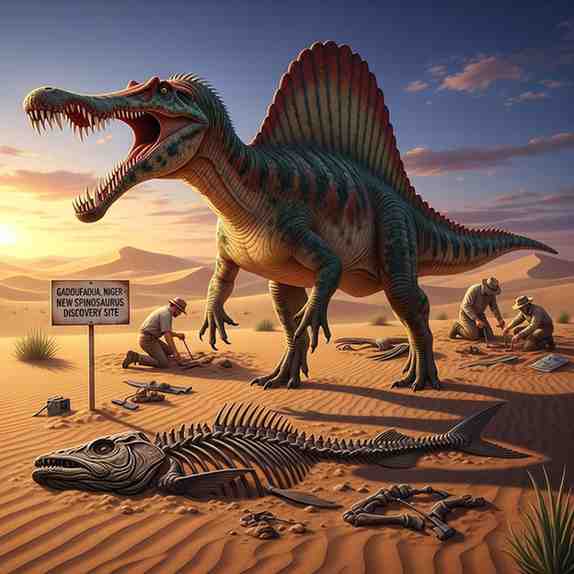
Spinosaurus mirabilis Reveals Riverine Predator Adaptations
Palaeontologists have identified a new dinosaur species in Niger’s Sahara Desert, providing important insights into Africa’s Cretaceous ecosystems. The species, named Spinosaurus mirabilis , lived approximately 95 million years ago and functioned as a dominant predator within ancient river systems. The discovery refines scientific understanding of spinosaurid evolution and ecological specialisation.
Fossil Discovery and Identification
The fossils were excavated from the remote Jenguebi site following a demanding desert expedition. Researchers recovered three skulls along with additional skeletal remains. Detailed anatomical analysis confirmed that the specimens represented a distinct species within the Spinosaurus lineage rather than variation within previously known taxa.
Specialised Riverine Predator
Spinosaurus mirabilis is estimated to have measured about 12 metres in length, with a body mass approaching seven tonnes. Despite its large size, its skeletal features indicate adaptation to semi-aquatic hunting.
Scientists characterised the dinosaur as a “hell heron” predator due to its inferred wading lifestyle. The nostrils were positioned further back on the skull, enabling partial submersion of the snout while breathing. Its conical, interlocking teeth formed an efficient mechanism for capturing fish, including large aquatic species such as coelacanths.
Unique Cranial Crest
A defining feature of the species is a 20-inch scimitar-shaped crest atop the skull. Compared to Spinosaurus aegyptiacus , the newly described species possessed a more elongated snout and relatively longer hind limbs. Researchers suggest the crest likely served a display function, potentially linked to mate attraction or social signalling.
Ecological Implications
The inland fossil location challenges earlier interpretations of Spinosaurus as a fully oceanic predator. Evidence increasingly supports a semi-aquatic, freshwater riverine lifestyle.
Exam-Focused Key Points
-
The Cretaceous Period spanned 145–66 million years ago.
-
Spinosaurids were theropod dinosaurs with semi-aquatic adaptations.
-
Coelacanths are ancient lobe-finned fishes termed “living fossils.”
-
The Sahara Desert once supported riverine ecosystems.
-
Cranial crests often indicate display behaviour in dinosaurs.
Month: Current Affairs - February 21, 2026
Category: Science | Paleontology