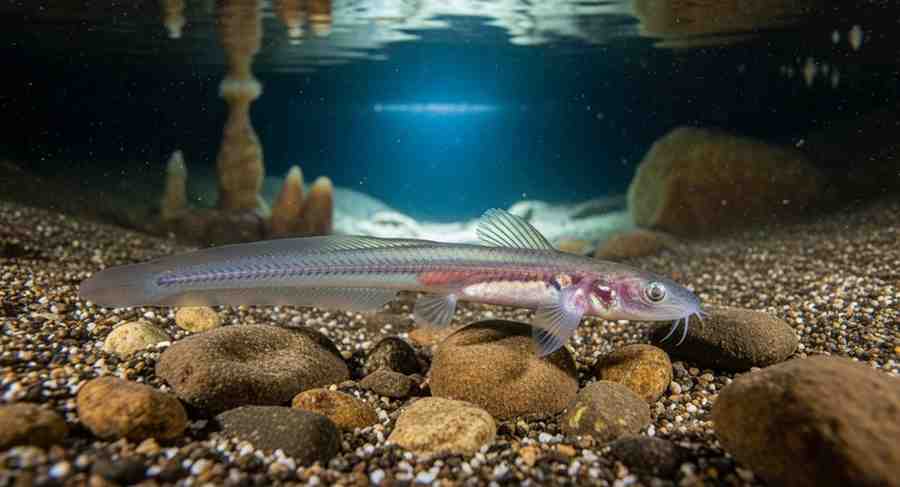
First Phreatobitic Fish from Northeast India Identified in Scientific Breakthrough
Researchers have identified a new genus and species of subterranean fish, Gitchak nakana , from a dug-out well in western Assam, marking the first aquifer-dwelling (phreatobitic) fish recorded in Northeast India. The discovery, published in Scientific Reports, highlights the global scientific importance of the finding.
Discovery in Groundwater Habitat
The study was led by Ralf Britz in collaboration with Assam Don Bosco University and international researchers. Specimens were collected on three occasions from the same well near the foothills of the Shillong Plateau close to the Brahmaputra Valley.
Unlike most subterranean fishes that inhabit caves, this species lives in groundwater aquifers—a rare ecological niche accounting for fewer than 10% of known subterranean fish species worldwide.
Distinct Troglomorphic Features
Gitchak nakana is a miniature cobitid loach exhibiting classic troglomorphic adaptations such as absence of eyes and pigmentation, reflecting life in complete darkness.
A unique anatomical characteristic is the complete absence of a skull roof, leaving the brain covered only by skin. This unprecedented skeletal structure within cobitid loaches justified classification as a new genus and species.
Evolutionary and Ecological Importance
Globally, over 300 fish species are known from subterranean habitats. The Shillong Plateau already supports cave-dwelling species like Schistura and Neolissochilus pnar , but this is the first aquifer-dwelling fish recorded from the region. The discovery provides new insights into evolutionary pathways among loaches and subterranean vertebrates.
Important Facts for Exams
-
Phreatobitic species inhabit groundwater aquifers.
-
Troglomorphic traits include eye and pigment loss.
-
Shillong Plateau is a hotspot of subterranean biodiversity.
-
Scientific Reports is a peer-reviewed journal under Nature Portfolio.
The finding underscores the ecological significance of groundwater ecosystems in Northeast India and calls for focused conservation efforts amid increasing environmental pressures on aquifers.
Month: Current Affairs - March 03, 2026
Category: Biodiversity | Northeast India