Why NASA is Saving the Swift Telescope from Falling Orbit
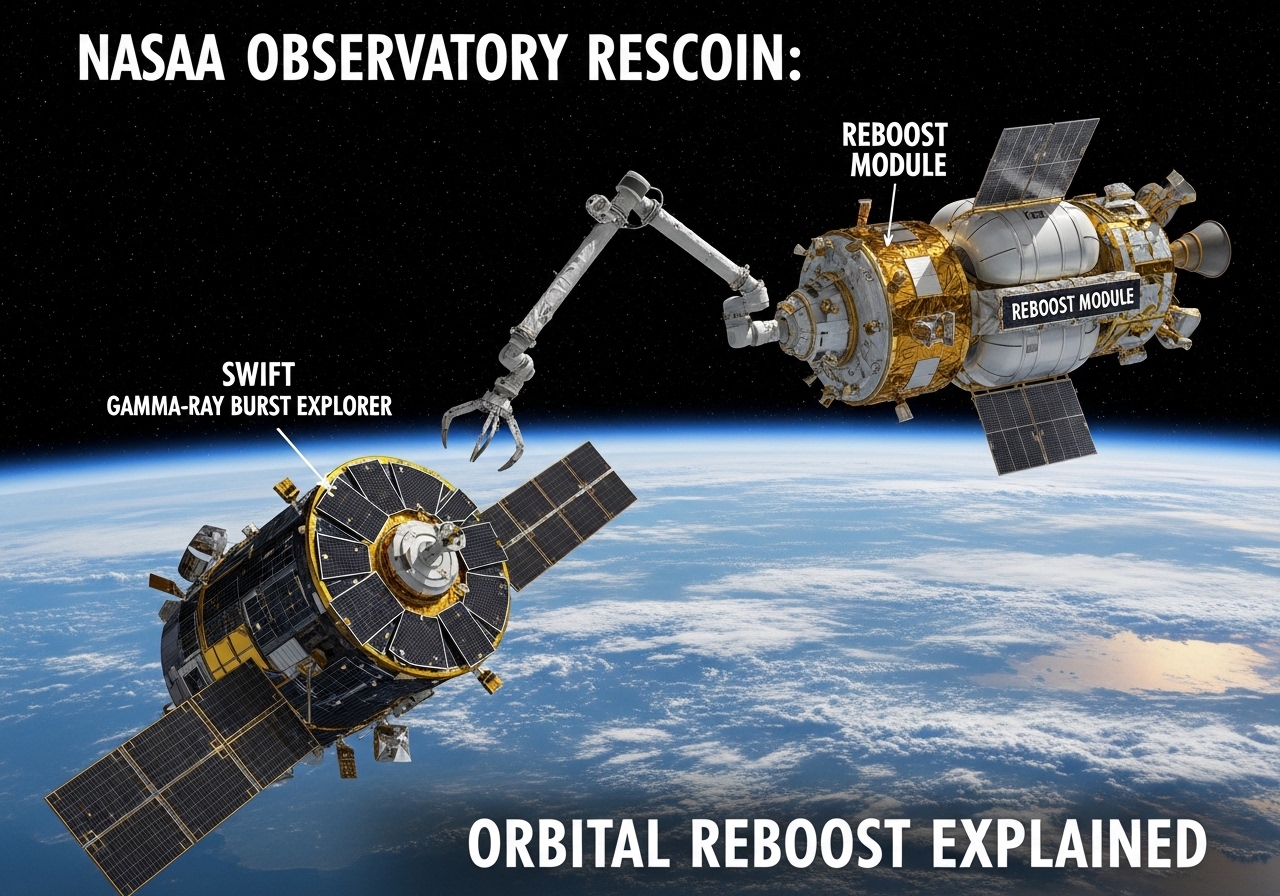
NASA has initiated a $30 million mission to prevent the ageing Neil Gehrels Swift Observatory from losing orbit and re-entering Earth’s atmosphere, marking a significant step in satellite servicing technology.
About the Swift Observatory
Launched in 2004 under NASA’s Medium Explorer (MIDEX) programme, the Swift Observatory is designed to study gamma-ray bursts—intense cosmic explosions that release enormous energy. It carries advanced instruments such as the Burst Alert Telescope, enabling rapid detection and follow-up observations. Over the years, it has contributed extensively to high-energy astrophysics and deepened understanding of the universe.
Reason Behind Orbital Decay
The satellite is gradually descending due to increased atmospheric drag in low-Earth orbit. Heightened solar activity has heated and expanded the upper atmosphere, causing more resistance to satellites. As a result, Swift’s orbit has fallen below 400 km, raising concerns about uncontrolled re-entry if corrective action is not taken.
Rescue Plan and Technology
NASA plans to use a robotic spacecraft developed by Katalyst Space Technologies to dock with the observatory. The robot will attach using specialised mechanisms and push the satellite to a safer orbit of around 550 km. This “reboost” operation is expected to extend the telescope’s operational life by nearly a decade. After completing the task, the servicing spacecraft will detach and safely burn up in the atmosphere.
Significance of the Mission
This mission demonstrates a shift towards in-orbit servicing rather than replacing ageing satellites. It offers a cost-effective method to extend mission lifespans and reduce space debris. However, it involves complex manoeuvres, including precise docking under dynamic orbital conditions, making it technologically challenging.
Exam-Focused Points
-
Swift Observatory launched in 2004 (MIDEX programme)
-
Studies gamma-ray bursts (high-energy cosmic events)
-
Orbital decay due to solar activity → increased atmospheric drag
-
Reboost target orbit: ~550 km
-
Life extension: ~10 years
-
Robotic servicing by Katalyst Space Technologies
Month: Current Affairs - March 28, 2026
Category: Space Technology