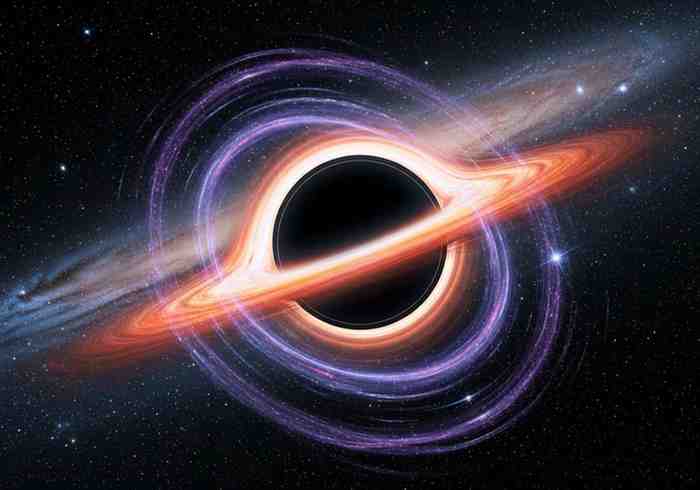
Overview
The existence of a supermassive black hole in the centre of the Milky Way has been the subject of a recent theoretical study that has challenged the long held belief. According to scientists, the object (called Sagittarius A+) may be a dense clump of dark matter. Although still under study, this concept may have a profound impact on the existing knowledge of galactic structure and gravity.
Traditional Sagittarius A* Knowledge.
Sagittarius A has long been known as a supermassive black hole by astronomers. This is determined by the fact that the neighbouring stars move very fast and they orbit the galactic centre at very high speeds. It has been observed that there was a compact object which had a mass of about four million times that of the Sun and this was in line with the prediction of black holes.
Dark Matter-Based Explanation
The new model suggests that the fermionic dark matter particles can create a dense core. This structure would not have a singularity or event horizon like a black hole. Rather, it would act like a huge object with a high gravity pull. The rotation of the galaxy would be further stabilised by a halo of dark matter surrounding it.
Contribution of S-Stars to the Debate.
Black hole theory S-stars are stars that revolve around the galactic centre and have long been used as a major piece of evidence in support of the black hole theory. But the new hypothesis is that dense dark matter core could also explain their motion. This casts doubt on the idea that the current observations are a conclusive way to show the existence of a black hole.
Implications for Astrophysics
The research has significant ramifications on astrophysics. The black holes have been observed to have a shadow through the observations made by the Event Horizon telescope in the appearance of rings. But the same effects might occur because of gravitational lensing of a dense dark matter core. In case it is validated, it would reinvent theories regarding the black holes and matter distribution in the galaxies.
Exam-Focused Key Points
- Sagittarius A + is at the centre of the Milky Way.
- Interaction of dark matter is mainly by way of gravity.
- S-stars revolve high-speedily around the centre of the galaxy.
- Black holes are characterised by event horizons and singularities.
- Gravitational lensing is a bending of light.
Practice Questions (with Answers)
Q1. And what is traditionally said Sagittarius A is?
Response: A large black hole.
Q2. What is the alternative explanation of the study?
Response: A thick centre of black mass.
Q3. What are S-stars?
Answer: Stars that revolve around the centre of the galaxy at a high rate.
Q4. What is one major aspect that is missing in the dark matter model?
Answer: Event horizon.
Q5. What phenomenon has the ability to form rings around
Month: Current Affairs - April 11, 2026
Category: Space Science | Astrophysics