Mangrove Ecosystems in Focus Amid Coastal Development Debate
Mangroves have recently gained attention following a legal and environmental debate linked to the Versova-Bhayandar coastal road project. These unique coastal ecosystems are vital for ecological balance, making their conservation a key concern in the context of infrastructure expansion.
What are Mangroves?
Mangroves are salt-tolerant trees and shrubs found in intertidal zones of tropical and subtropical coastlines. They grow in saline or brackish water and form a natural boundary between land and sea, playing a crucial role in coastal ecosystems.
Unique Adaptations and Characteristics
Mangroves possess specialised adaptations to survive harsh coastal conditions. Their roots can filter or expel excess salt, while aerial roots called pneumatophores enable respiration in waterlogged soils. Prop roots provide stability against strong tides and winds. Another key feature is vivipary, where seeds begin to germinate while attached to the parent plant, improving survival rates.
Ecological Importance and Carbon Storage
Mangroves are among the most efficient natural carbon sinks, storing large amounts of carbon and helping mitigate climate change. They act as natural barriers against coastal erosion, cyclones, and storm surges. Additionally, they serve as breeding and nursery grounds for numerous marine species, supporting biodiversity and fisheries.
Distribution of Mangroves in India
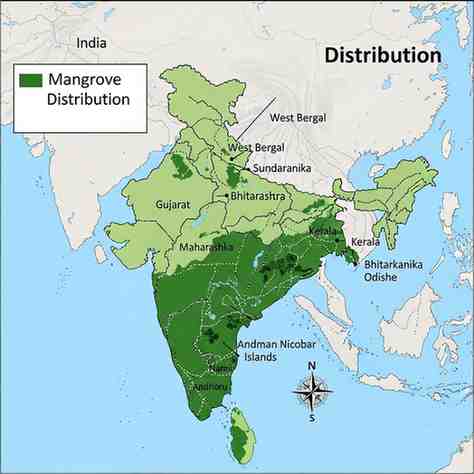
In India, mangroves are widely distributed across coastal regions. Major areas include the Sundarbans, deltas of Mahanadi, Godavari, and Krishna rivers, and the Pichavaram mangroves in Tamil Nadu. Other important locations are Bhitarkanika in Odisha, the Gulf of Kutch in Gujarat, and island ecosystems of the Andaman and Nicobar Islands and Lakshadweep.
Exam-Focused Points
-
Mangroves grow in intertidal saline/brackish zones .
-
Key adaptation: pneumatophores (aerial roots) .
-
Reproduction: vivipary .
-
Role: carbon sink + coastal protection .
-
Major regions: Sundarbans, Bhitarkanika, Pichavaram .
-
Importance: biodiversity, fisheries, climate regulation .
Month: Current Affairs - March 23, 2026
Category: Environment, Climate Change