Scientists Decode Evolution of Ladakh Magmatic Arc in Himalaya
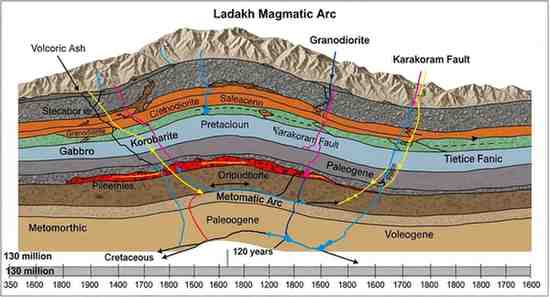
Scientists have reconstructed the evolution of the Ladakh Magmatic Arc (LMA), uncovering a geological history spanning nearly 130 million years. The findings provide critical insights into long-term interactions between the Indian and Eurasian plates, predating the rise of the Himalaya when the region lay above the ancient Neo-Tethys Ocean.
Formation under the Neo-Tethys Ocean
Before the Himalayan uplift, Ladakh was situated above the Neo-Tethys Ocean, where oceanic crust was subducting beneath the Eurasian margin. This process led to the formation of the Ladakh Magmatic Arc, a chain of igneous activity extending from the Jurassic to the Eocene period (about 201–34 million years ago). The arc represents a classic subduction-related volcanic system formed in an oceanic setting.
Scientific Findings and Rock Chemistry
Researchers from the Wadia Institute of Himalayan Geology analysed geochemical and isotopic signatures of rocks to trace the arc’s development. Samples from the Dras–Nidar Island Arc Complex, the Ladakh Batholith, and mafic dykes revealed that the arc originated from northward subduction of the Neo-Tethyan plate beneath Eurasia. Variations in rock composition indicate evolving magma sources and tectonic conditions.
Three Phases of Magmatic Evolution
The study identifies three key stages of evolution:
-
160–110 million years ago: Dominance of volcanic island arcs with mantle-derived magma.
-
103–45 million years ago: Formation of granitic bodies (Ladakh Batholith) with increased continental input.
-
Post-45 million years: Transition to post-collisional processes following the India–Eurasia collision, altering magma chemistry and tectonics.
Implications for Himalayan Evolution
The Ladakh Magmatic Arc represents a long-extinct volcanic system that records the transition from oceanic subduction to continental collision. Increasing crustal influence in later magmas reflects intensifying convergence between plates. This geological record provides vital evidence for understanding the formation and evolution of the Himalaya.
Exam-Focused Points
-
Ladakh Magmatic Arc (LMA) formed due to subduction of Neo-Tethys plate.
-
Time span: Jurassic to Eocene (201–34 million years ago) .
-
Key units: Dras–Nidar Arc Complex & Ladakh Batholith .
-
Shows transition from subduction to continental collision .
-
Three phases of magmatic evolution identified.
-
Crucial for understanding India–Eurasia plate interaction .
Month: Current Affairs - March 19, 2026
Category: Geography, Geology