names are passed down from mother to daughter. This is very different from the mainstream Indian system, which is patrilineal. In a matrilineal system, women have more power and respect. The Koraga also have a unique clan structure called “bali.” Each bali is a group of families that share a common ancestor. The bali decides who can marry whom. It also plays a role in settling disputes.
Leadership: The Role of Mooppan
The Koraga community is led by a village elder called the Mooppan. The Mooppan is the most senior person in the village. He is respected by everyone. His job is to ensure the well-being of all community members. He settles fights, organises festivals, and speaks for the village in front of outsiders. The Mooppan also keeps the community’s traditions alive. He knows the old stories, songs, and rituals. When a Koraga family has a problem, they go to the Mooppan first, not to the police or the court.
Music and Dance: The Heart of Koraga Culture
Music is very important to the Koraga tribe. They have two main musical instruments. One is the dholu (a type of drum). The other is the voote (a flute). The rhythmic beating of the dholu is a key part of their cultural identity. They play the drum during ceremonies, weddings, and community gatherings. The flute adds a soft, melodic tone. The Koraga also perform folk dances. Men and women dance together in circles. The dances tell stories of nature, spirits, and daily life. These traditions are passed down from parents to children. But with younger people moving to cities, the future of these arts is uncertain.
Religion and Beliefs
The Koraga tribe follows Hinduism, but their beliefs are very different from mainstream Hindu practices. They worship spirits known as “Bhutas.” Bhutas are local deities that live in forests, rivers, or rocks. The Koraga believe that these spirits can bring good luck or cause harm. So they perform rituals to please them. They also believe in magic. Some Koraga men and women are considered healers. They use herbs, chants, and rituals to cure sickness or ward off evil. These beliefs are not written in any book. They are passed down through stories and songs.
The Housing Crisis: What the UN Report Said
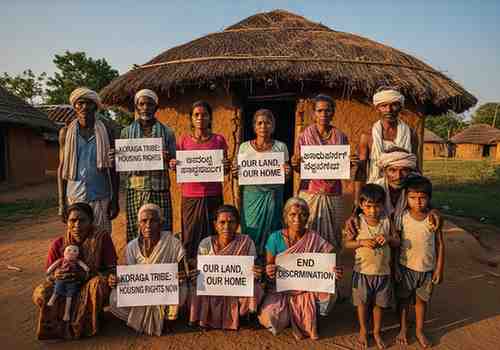
The UN-Habitat World Cities Report 2026 recently mentioned the Koraga tribe. The report said that caste barriers and policy gaps continue to deny many communities access to secure housing. The Koraga are a perfect example. Even though government schemes exist, the benefits do not reach them. Landlords refuse to sell them land. Banks refuse to give them loans. Neighbours object when they try to build houses on government land. As a result, many Koraga families live in thatched huts with no electricity or running water. Children grow up in unhealthy conditions. The report called this a “deep housing inequality” that needs urgent attention.
What Can Be Done?
The Koraga tribe needs help in several ways. First, the government must enforce housing schemes strictly. Land should be given to every Koraga family. Second, banks should give low-interest loans for house construction. Third, schools in Koraga areas should have free meals and books to keep children in school. Fourth, the government should create jobs for Koraga adults in their own villages so they do not have to migrate. Fifth, the community’s culture and language should be preserved through school programmes and cultural festivals. With the right support, the Koraga tribe can live with dignity and pride.
Conclusion
Month: Current Affairs - May 27, 2026
Category: Tribal Communities, Social Justice