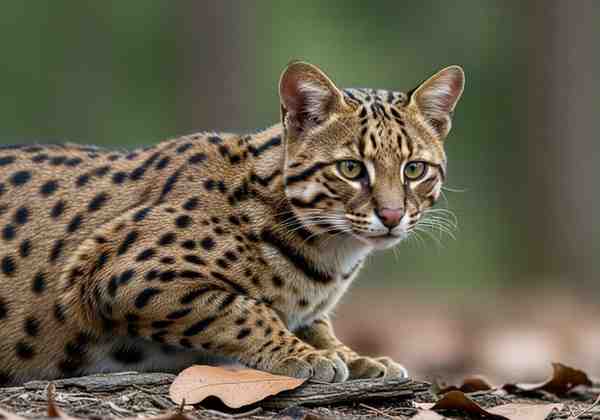
Declining Jungle Cat Population Raises Concern
Recent studies show a decline in the population of the Jungle Cat, highlighting the need to protect habitats outside protected areas. Although this species is adaptable, it is facing increasing pressure due to human activities and land-use changes.
About the Jungle Cat
The Jungle cat, also known as the Swamp Cat or Reed Cat, is a medium-sized wild feline. It is the largest species in the Felis genus and is found across Asia and parts of Africa. Its name is linked to the Caucasus region, where it was first identified.
Physical Features and Behaviour
The Jungle cat has long legs, a slim body, and large ears with black tufts. It has yellow eyes, a white muzzle, and light stripes on its limbs. Females are usually smaller than males. Unlike many wild cats, it is active during early morning and evening rather than only at night.
Habitat and Distribution
This species prefers open landscapes such as grasslands, wetlands, and scrub areas. It is commonly found in agricultural regions and avoids dense forests and crowded cities. Its distribution includes India, Nepal, Central Asia, Southeast Asia, and parts of Africa.
Exam-Focused Points
-
Scientific name: Felis chaus
-
Type: Medium-sized wild cat
-
IUCN Status: Least Concern
-
Protection: Schedule II, Wildlife Protection Act, 1972
-
Habitat: Grasslands, wetlands, scrublands
Threats and Conservation Needs
Despite being listed as Least Concern, the Jungle cat is declining in many areas. Habitat loss, wetland destruction, and expansion of agriculture are major threats. Since many of these cats live outside protected areas, conservation efforts must include farmlands and community lands to ensure their survival.
Month: Current Affairs - March 31, 2026
Category: Environment, Biodiversity