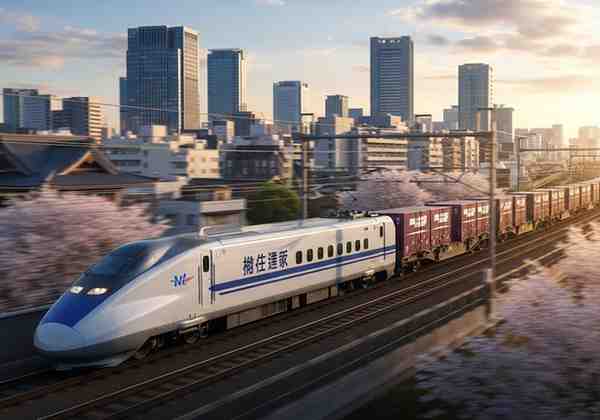
Freight Shinkansen Explained: High-Speed Cargo Revolution in Japan
Japan has introduced the world’s first dedicated freight-only Shinkansen, marking a major innovation in high-speed logistics and sustainable transport solutions.
Transformation of the Shinkansen
The initiative is led by East Japan Railway Company, which has modified the E3 series bullet train for cargo use. Passenger seats have been removed and interiors redesigned with reinforced flooring and open storage layouts. The train can carry around 1,000 boxes or nearly 17.4 tonnes of goods while maintaining speeds of up to 275 kmph.
Operational Route and Efficiency
The freight service runs along the Tohoku Shinkansen route between Morioka and Tokyo. The journey is completed in just over three hours, offering rapid transport without the need for new infrastructure. In some operations, freight units are attached to passenger trains, optimising track usage and improving efficiency.
Cargo Type and Strategic Role
The system is designed to handle high-value and time-sensitive goods such as seafood, dairy products, agricultural produce and precision instruments. It is particularly suitable for fragile items like semiconductors and medical supplies due to minimal vibration during transit. This positions the freight Shinkansen as a middle ground between conventional rail freight and expensive air cargo.
Evolution and Future Implications
The concept emerged during the COVID-19 pandemic when passenger demand declined, allowing experimental cargo use in bullet trains. It has now evolved into a full-scale logistics model. By reducing dependence on road and air transport, the system supports lower carbon emissions and more efficient supply chains. This innovation could influence global adoption of high-speed rail freight systems.
Exam-Focused Points
-
First freight-only Shinkansen introduced by Japan
-
Based on E3 series bullet train
-
Speed: up to 275 kmph
-
Capacity: ~17.4 tonnes (1,000 boxes)
-
Route: Morioka–Tokyo (Tohoku Shinkansen)
-
Suitable for high-value, time-sensitive goods
Month: Current Affairs - March 28, 2026
Category: Infrastructure, Transport