Overview
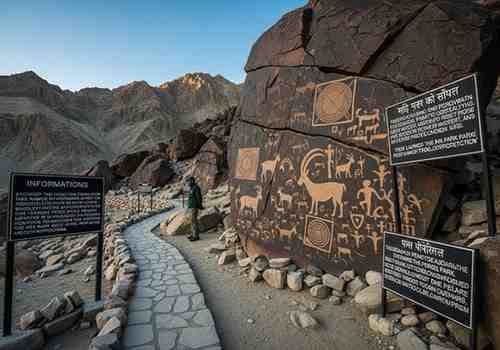
India In a historic move towards heritage conservation, the first Petroglyph Conservation Park was opened in Ladakh on April 19, 2026. Vinai Kumar Saxena initiated the project along the Indus River, which seeks to preserve centuries old carved rock reliefs that are endangered by tourism, development of infrastructures and environment degradation.
Understanding Petroglyphs
Petroglyphs are prehistoric engravings that have been cut on the surface of rocks by the ancient communities. They are useful archaeological sources of evidence of early human life, migration and belief systems. The carvings found in Ladakh show hunting scenes, such as ibex and snow leopards; as well as Buddhist symbols, reflecting changes in culture over time.
Need for Conservation
In Ladakh, there are almost 400 sites of petroglyphs, most of which are on the river valleys of Indus and Zanskar. Clustered sites are relatively safe, but isolated carvings are at risk due to the activities of road constructions, explosions, and ignorance. The petroglyphs that are at risk will be moved to a safe place in the conservation park and preserved and educated to the public.
Institutional Collaboration
A Memorandum of Understanding has been signed between the Archaeological Survey of India and Ladakh’s Department of Archives, Archaeology and Museums. This collaboration will guarantee scientific protection and conservation protection in the long term. Inscriptions in languages like Sanskrit, Chinese, and Arabic, notably, underscore the historic role of Ladakh as a cultural crossroads.
Community Role and Heritage Tourism.
The project also fosters sustainable tourism by heritage routes such as petroglyph and Buddhist routes. The governments focused on the involvement of the community, calling on the people, monks, and young people to be guardians. The project will work towards the balance between conservation and development in Himalayan areas that are ecologically vulnerable.
Exam-Focused Key Points
- First Petroglyph Conservation Park in Ladakh (2026).
- Petroglyphs are carvings on the rocks without any paint (the pictographs are painted).
- Ladakh hosts ~400 rock art sites.
- ASI working together in scientific conservation.
- Promotes community involvement and heritage tourism.
- World Heritage Day is on the 18th of April.
MCQ
Q1. Petroglyphs and pictographs are different in that the former are:
A. Painted on walls
B. Printed on paper
C. Carved or incised on rocks.
D. Written in manuscripts
Answer: C
Elucidation: Petroglyphs are carved or inscribed images on the rock surface and pictographs are painted images.
Month: Current Affairs - April 20, 2026
Category: Culture | Art & Heritage