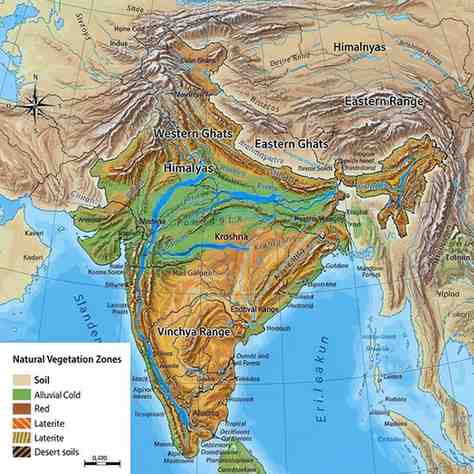
🌊 Rivers of India
-
The Ganga River originates from which glacier?
A) Pindari Glacier
B) Gangotri Glacier
C) Siachen Glacier
D) Zemu Glacier
Answer: B) Gangotri Glacier
Explanation: The Ganga originates as the Bhagirathi from the Gangotri Glacier in Uttarakhand; it later joins the Alaknanda to form the Ganga at Devprayag.
-
Which river is known as the “Sorrow of Bihar”?
A) Gandak
B) Kosi
C) Ghaghara
D) Son
Answer: B) Kosi
Explanation: The Kosi frequently changes its course and causes floods in Bihar, earning it the name “Sorrow of Bihar.”
-
The Godavari River is also called:
A) Dakshin Ganga
B) Krishna’s Sister
C) Vridha Ganga
D) Both A and C
Answer: D) Both A and C
Explanation: The Godavari is India’s second-longest river, often called Dakshin Ganga (Ganga of the South) or Vridha Ganga (Old Ganga).
🏔️ Mountains of India
-
The highest peak in India (in Indian-administered territory) is:
A) Mount Everest
B) Kanchenjunga
C) Nanda Devi
D) K2
Answer: B) Kanchenjunga
Explanation: Kanchenjunga (8,586 m) is the highest peak located entirely within India (Sikkim). K2 (8,611 m) lies in Pakistan-occupied territory.
-
Which of the following is a volcanic mountain in India?
A) Nilgiri Hills
B) Mount Abu
C) Doddabetta
D) Barren Island
Answer: D) Barren Island
Explanation: Barren Island in the Andaman Sea hosts India’s only active volcano.
-
Which pass connects Manali to Leh?
A) Rohtang Pass
B) Nathu La
C) Shipki La
D) Bara Lacha La
Answer: A) Rohtang Pass
Explanation: Rohtang Pass in Himachal Pradesh connects the Kullu Valley with Lahaul and Spiti valleys and further to Leh.
☀️ Climate of India
-
Which type of climate does India mainly experience?
A) Equatorial
B) Tropical monsoon
C) Mediterranean
D) Desert
Answer: B) Tropical monsoon
Explanation: India’s climate is classified as tropical monsoon , marked by distinct wet and dry seasons.
-
The retreating monsoon causes rainfall in:
A) Punjab and Haryana
B) West Bengal
C) Tamil Nadu
D) Gujarat
Answer: C) Tamil Nadu
Explanation: Tamil Nadu receives most of its rain from the northeast monsoon winds during October–December.
-
The place that receives the highest annual rainfall in India is:
A) Cherrapunji
B) Mawsynram
C) Agumbe
D) Laitkynsew
Answer: B) Mawsynram
Explanation: Mawsynram in Meghalaya records the highest average annual rainfall in India, exceeding 11,000 mm.
🌱 Soils of India
-
Which soil covers the largest area in India?
A) Alluvial soil
B) Black soil
C) Red soil
D) Laterite soil
Answer: A) Alluvial soil
Explanation: Alluvial soils cover about 40% of India’s land area, mainly in the northern plains and river valleys.
-
The black soil of India is best suited for:
A) Rice
B) Cotton
C) Tea
D) Wheat
Answer: B) Cotton
Explanation: Black soil (Regur) , rich in iron and lime, retains moisture and is ideal for cotton cultivation in the Deccan region.
-
Which of the following soils is rich in iron but poor in nitrogen and phosphorus?
A) Alluvial soil
B) Red soil
C) Laterite soil
D) Black soil
Answer: B) Red soil
Explanation: Red soils derive their color from iron oxides; they are deficient in nitrogen and phosphorus, thus require fertilizers.
🌿 Natural Vegetation of India
-
Tropical Evergreen Forests are found mainly in:
A) Rajasthan
B) Western Ghats and Northeast India
C) Punjab
D) Ladakh
Answer: B) Western Ghats and Northeast India
Explanation: Tropical evergreen forests occur in areas with high rainfall and humidity, such as the Western Ghats and northeastern states.
-
Which forest type dominates the Gangetic plains?
A) Tropical Evergreen
B) Tropical Deciduous
C) Thorn Forest
D) Alpine Forest
Answer: B) Tropical Deciduous
Explanation: The Tropical Deciduous Forests (monsoon forests) are the most widespread type in India, found in the plains and foothills.
-
The state having the largest forest cover in India (by area) is:
A) Madhya Pradesh
B) Arunachal Pradesh
C) Chhattisgarh
D) Odisha
Answer: A) Madhya Pradesh
Explanation: Madhya Pradesh has the largest forest area, while Mizoram has the highest percentage of forest cover relative to its area.
Month: Current Affairs - Nov 05, 2025
Category: