Overview
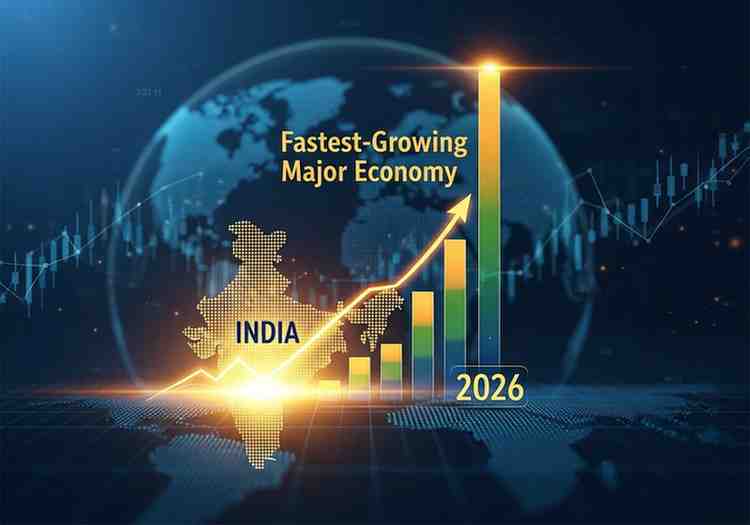
India is expected to still be the fastest-growing major economy in 2026, and the International Monetary Fund projects growth in its GDP of 6.5%. This perspective is strong despite the international pressures like geopolitical tensions, inflationary pressures, and volatile energy markets. Strong domestic demand and good macroeconomic fundamentals are the major factors that have contributed to the resilience.
Comparative Analysis with the World and India.
IMF estimates the growth of the world to be 3.1 in 2026 and 3.2 in 2027 which is much lower than India. China is likely to increase by approximately 4.9, whereas the United States could achieve approximately 2.3 increase. The inflation and slow growth experienced by many emerging economies puts India in a relatively better position.
Carryover Growth Momentum
The good performance of India in 2025 in terms of growth in GDP, which is revised to 7.6 has left a carryover effect in 2026. This momentum has been enhanced by improved global trade conditions such as reduction of tariff uncertainties. This continuity is indicative of structural strength of the economy.
Domestic Demand as Growth Driver.
The model of growth in India is mainly consumption based, which is facilitated by increasing investment and high domestic market. Compared to the economies that rely on exports, India enjoys robust domestic consumption, which helps it to absorb external shocks. Nevertheless, the increase in prices of crude oil because of tensions in West Asia is one of the main vulnerabilities.
Risks and Policy Challenges.
Although there are optimistic forecasts, there are threats due to inflation both world-wide and instability in the geopolitical and energy prices. Policymakers need to practice fiscal discipline, tame inflation, and maintain the flow of investments. Further structural reforms and demand support will be needed to ensure growth leadership.
Exam-Focused Key Points
- IMF projects India’s GDP growth at 6.5% (2026–27).
- The world is projected to grow at 3.1% in 2026.
- Domestic demand led to the growth of India.
- A significant external risk is oil price volatility.
- Momentum is supported by carryover effect of 7.6% growth in 2025.
Practice Questions (with Answers)
Q1. Which is the projected GDP growth rate of India by the IMF in 2026?
Answer: 6.5%.
Q2. Which is the approximate percentage of growth globally in 2026?
Answer: 3.1%.
Q3. What is the main catalyst to the economic growth of India?
Answer: Domestic demand.
Q4. Identify one of the significant external threats to the Indian economy.
Reason: Increasing oil prices (energy price volatility).
Month: Current Affairs - April 15, 2026
Category: Economy | Growth Trends