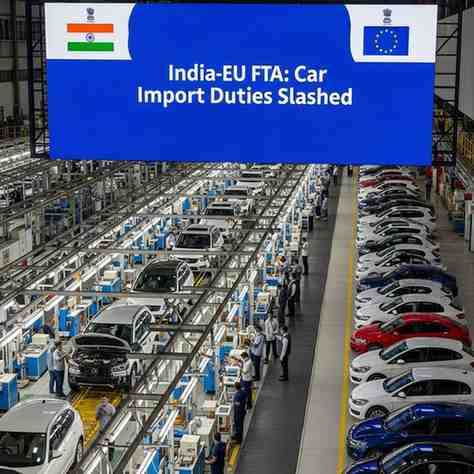
India to Open Automobile Market Under Proposed India–EU Free Trade Agreement
India is preparing for one of its most significant trade policy shifts in decades by agreeing to substantially reduce import duties on European passenger vehicles under a proposed India–European Union Free Trade Agreement (FTA) . The move marks a clear departure from India’s long-standing protectionist approach to the automobile sector and is being viewed as a breakthrough in negotiations that have remained stalled for more than ten years.
Major Tariff Reductions on Imported Cars
As per the proposed framework, India will immediately reduce import duties to 40 per cent on a limited quota of EU-manufactured passenger cars priced above €15,000 . Currently, India imposes duties of up to 110 per cent on fully built imported cars. Over the implementation period of the agreement, these tariffs could be lowered further, potentially reaching 10 per cent , making it one of the deepest concessions India has ever offered in the auto sector.
The reductions are expected to apply selectively, balancing market access with protection for domestic manufacturers.
Opportunities for European Automakers
The tariff cuts are set to benefit leading European carmakers such as Volkswagen, Mercedes-Benz and BMW . High import duties have so far limited the introduction of premium and niche models into India, forcing many brands to rely on local assembly. Lower tariffs will allow manufacturers to price imported models more competitively and assess consumer demand before expanding local production or investing in new plants.
For Europe’s auto industry, India represents a fast-growing market at a time when demand in traditional markets is slowing.
Protection for India’s Electric Vehicle Ecosystem
A key safeguard in the proposed deal is the exclusion of electric vehicles (EVs) from tariff reductions for the first five years . This measure is designed to protect India’s emerging EV industry, led by domestic players such as Tata Motors and Mahindra & Mahindra , which are scaling up production and technology capabilities.
After the protection window, EVs are expected to be gradually brought under the tariff reduction schedule, aligning them with conventional vehicle imports.
Broader Trade and Strategic Context
The automobile concession is part of a wider trade package that could expand India–EU cooperation in textiles, apparel, jewellery, pharmaceuticals and services . Strategically, the timing is important. Indian exporters are facing uncertainty due to higher tariffs in the US market, while European companies are seeking growth opportunities beyond mature economies.
If concluded, the FTA would significantly deepen economic ties between India and the EU and reshape India’s approach to trade liberalisation.
Imporatnt Facts for Exams
-
India–EU FTA talks have been ongoing intermittently for over a decade
-
India currently imposes import duties of up to 110% on fully built cars
-
Proposed tariff cut lowers duties to 40% , with potential reduction to 10%
-
Electric vehicles are excluded from tariff cuts for
Month: Current Affairs - January 27, 2026
Category: India–EU Relations | Free Trade Agreement