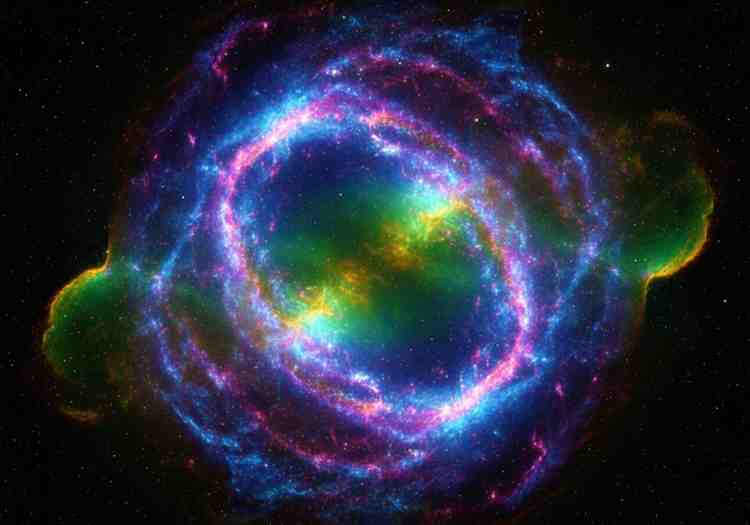
NASA’s IXPE Mission Reveals Structure of RCW 86 Remnant
Recent observations by NASA using the Imaging X-ray Polarimetry Explorer have provided deeper insights into RCW 86, a supernova remnant believed to be about 2,000 years old. These findings enhance earlier studies conducted through Chandra X-ray Observatory and XMM-Newton, offering a more detailed understanding of its structure and evolution.
Expansion Behaviour and Shock Dynamics
The IXPE mission focused on the outer regions of RCW 86, revealing that the remnant initially expanded rapidly before its velocity slowed upon reaching the boundary of a surrounding low-density cavity. This interaction generated a reflected shock wave, which provides important clues about how energy is redistributed within supernova remnants. Such shock interactions are key to understanding particle acceleration in space.
Role of the Surrounding Cavity
Earlier research had identified a large, low-density cavity around RCW 86. This environment allowed the explosion to expand more quickly in its early stages compared to typical remnants. Scientists now confirm that this cavity significantly influenced the remnant’s irregular shape and long-term evolution, demonstrating the importance of environmental conditions in cosmic events.
Multi-Observatory Data Integration
The study integrates IXPE data with observations from Chandra and XMM-Newton to create composite X-ray images. Different energy levels are represented through colour mapping, enabling precise analysis of structural variations and energy distribution. This multi-instrument approach improves accuracy in interpreting high-energy astrophysical phenomena.
Exam-Focused Points
-
RCW 86: ~2,000-year-old supernova remnant
-
IXPE: Studies X-ray polarisation in space
-
Chandra & XMM-Newton: Major X-ray observatories
-
Key concept: Shock waves and particle acceleration
-
Cavity effect: Controls expansion and structure of remnant
Month: Current Affairs - March 29, 2026
Category: Space | Astrophysics | NASA