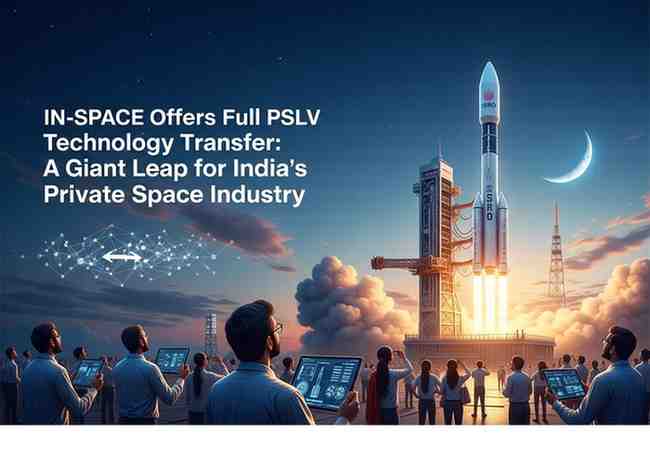
this PSLV transfer happens, it will be the second ISRO rocket to be fully transferred to industry. The first was the Small Satellite Launch Vehicle (SSLV). In September 2025, a technology transfer agreement was signed for the SSLV. It was a three-stage vehicle designed to launch small satellites under 500 kg into low-earth orbit. Hindustan Aeronautics Limited (HAL) became the first Indian company to receive complete launch vehicle technology. The ₹511 crore deal grants HAL a non-exclusive license for the SSLV technology. It allows HAL to independently own, build, market, and launch the rocket. This successful precedent has paved the way for the larger and more complex PSLV transfer.
Why Are These Reforms Important?
These reforms are part of a larger national vision. The government wants to shift from an ISRO-led production model to an industry-driven launch ecosystem. For decades, ISRO has handled almost everything. Now, the focus is on opening the space sector to private players. NSIL, the commercial arm of the Department of Space, is leading this charge. It acts as a bridge between ISRO's technical expertise and the private sector’s manufacturing and business skills. This partnership is designed to make India a major player in the global space market.
Final Thoughts on the Future
The PSLV remains India’s most dependable launcher, with more than 50 successful missions. Transferring its technology is a huge responsibility. It also raises questions about industry readiness. The slow progress of the first privatisation experiments highlights the complexity of moving such high-tech capability from a state-run programme into commercial hands. However, the government is determined to accelerate this transition. The message is clear: India wants its private industry to build, own, and fly its own rockets for the world.
Exam-Focused Points
-
PSLV is a medium-lift launch vehicle used for sun-synchronous and polar orbits.
-
IN-SPACe offered full technology transfer of PSLV on 21 May 2026.
-
2022 Contract: ₹860 crore deal to HAL-L&T consortium for five PSLVs.
-
First Rocket Delay: Was expected in 24 months, now delayed.
-
ISRO Support: Will provide 30 months or 2 vehicle launches of hand-holding.
-
Eligibility: Indian-owned, 7 years operations, 5 years aerospace experience, turnover ₹400 cr+ or valuation ₹1,000 cr+.
-
SSLV Success: First rocket fully transferred to HAL in September 2025.
-
NSIL is the commercial arm of the Department of Space.
FAQs
Q1: What is the main goal of the PSLV technology transfer?
Ans: To enable Indian industry to build, own, and operate PSLV rockets for the global satellite launch market.
Q2: Which organisation made this technology transfer offer?
Ans: The Indian National Space Promotion and Authorisation Centre (IN-SPACe).
Q3: What is the financial eligibility requirement for interested companies?
Ans: They must have an average turnover above ₹400 crore or a valuation exceeding ₹1,000 crore.
Month: Current Affairs - May 22, 2026
Category: Space, Economy