Overview
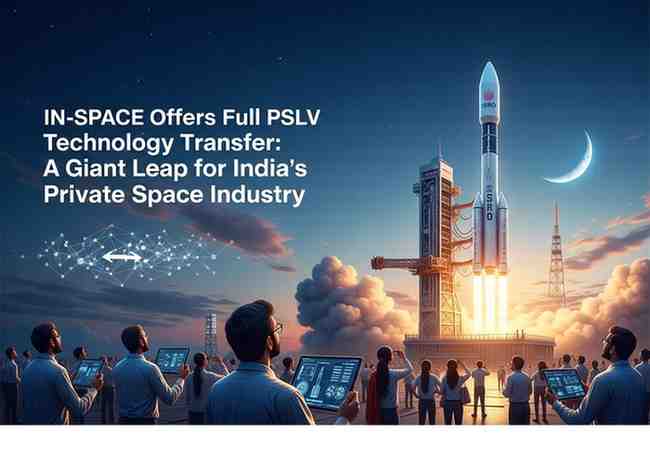
The Indian National Space Promotion and Authorisation Centre (IN-SPACe) has made a bold announcement. It is offering the complete transfer of technology for the Polar Satellite Launch Vehicle (PSLV) to Indian industry. This news arrived on 21 May 2026. The offer is interesting because it comes before the first privately built PSLV has even completed its launch. This move is a big step in India’s plan to let private companies take a leading role in space activities.
What Is the Polar Satellite Launch Vehicle (PSLV)?
The PSLV is a reliable rocket. It is designed and operated by the Indian Space Research Organisation (ISRO). Its main job is to place satellites into polar and sun-synchronous orbits. These are special paths around the Earth used for weather monitoring, mapping, and scientific research. The PSLV is a medium-lift launch vehicle. Over the years, it has become famous for its consistent success. It has launched major missions like Chandrayaan-1, the Mars Orbiter Mission, and Astrosat. It has also deployed hundreds of small satellites for other countries. The rocket has a four-stage design, which uses a mix of solid and liquid fuel to achieve its goals.
The Road to Privatisation: A Quick Look Back
India’s journey to privatise rocket making started in 2022. Back then, NewSpace India Limited (NSIL) awarded a ₹860-crore contract to a consortium of Hindustan Aeronautics Limited (HAL) and Larsen & Toubro (L&T). The task was to build five PSLV rockets. It was a big deal because it was the industry’s first attempt at end-to-end production of India’s workhorse rocket. The first rocket from this consortium was expected to be ready in 24 months. However, it has now taken nearly double that time, which has been a learning experience for everyone involved.
What Is This New Technology Transfer Offer?
The new offer from IN-SPACe is different. It is for a full transfer of technology (ToT). This means the selected private company will not just build parts. They will learn everything about the PSLV. They will get the complete knowledge to realise, operate, and commercialise PSLV launches in the global medium-lift satellite market . This is the ultimate goal for industry. It takes the model from a simple manufacturing contract to full ownership and operation.
How Will the Technology Transfer Work?
The process is well-defined to ensure success. Once a company is selected, ISRO will provide infrastructural and hand-holding support . This support will last for a maximum of 30 months . The support will continue until the selected company builds and launches two PSLV vehicles. Whichever of these two conditions is met first will decide the end of ISRO’s direct hand-holding. This approach ensures that the private partner gains deep, practical knowledge before they have to operate independently.
Who Is Eligible for This Opportunity?
IN-SPACe has set strict criteria. The goal is to choose a partner with real experience. The Expression of Interest (EoI) is open only to Indian-owned non-government entities. The chosen company must have at least seven years of operations. It also needs five years of specific space or aerospace experience. The financial requirements are also tough. The company must have an average turnover above ₹400 crore. Alternatively, it can have a valuation exceeding ₹1,000 crore. This ensures that only serious and capable players will enter the race.
The Success of SSLV: A Model for the Future
If
Month: Current Affairs - May 22, 2026
Category: Space, Economy