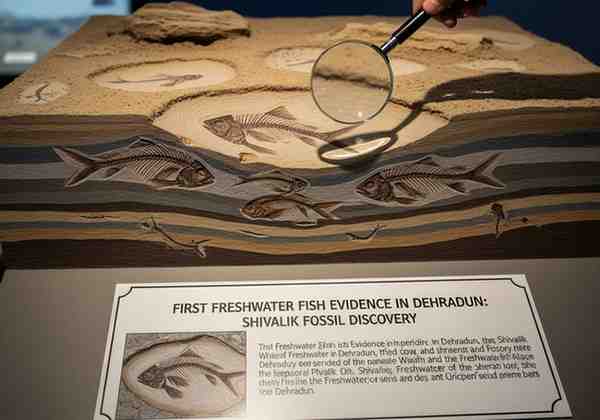
Freshwater Fish Fossils Found in Shivalik Region.
The first palaeontological discovery was made in the Shivalik Hills off Dehradun where fossils of freshwater fish were discovered. The discovery provides a new dimension to the region previously known primarily through terrestrial fossils and provides the information about ancient ecosystems of northern India.
Findings at Mohand and Discovery.
Scientists of the Wadia Institute of Himalayan Geology and partner institutions found the fossils near Mohand. Scientists discovered three freshwater fish groups, snakehead, goby, and gourami, which had otoliths (ear bones). Interestingly, it is the first known gourami fossil in India and the second in the world, the first having been discovered in Sumatra.
Learning the Pliocene Ecosystem.
The fossils date to be approximately 4.5 million years old, the Pliocene period. Their presence means the presence of a stable freshwater ecosystem, calm water bodies, and dense vegetation. Such species as snakehead and gourami are usually adapted to such conditions which should indicate favourable climatic conditions at that time.
Biogeographical and Evolutionary Significance.
The discovery provides important clues about the evolutionary history of the Osphronemidae family, which includes gourami fishes. It also indicates the historical ecological connections between South and Southeast Asia which suggests that along with the regions, similar environmental conditions existed previously and they facilitated the movement and distribution of species.
Exam-Focused Points
- Location: Shivalik Hills (Dehradun region)
- Fossils: otoliths (bones in the ear of fish).
- Age: c. 4.5 mya (Pliocene age)
- Species: Snakehead, goby, gourami.
- Gourami: Indian debut.
Scope for Future Research
The paper mentions the potential of finding fossils of other animals besides land animals in the Shivalik region which is unexplored. To obtain these remains, researchers treated huge amounts of sediment, implying that additional work may uncover additional information regarding ancient freshwater biodiversity and environmental conditions in the Indian subcontinent.
Month: Current Affairs - April 06, 2026
Category: Geography - Environment