Image

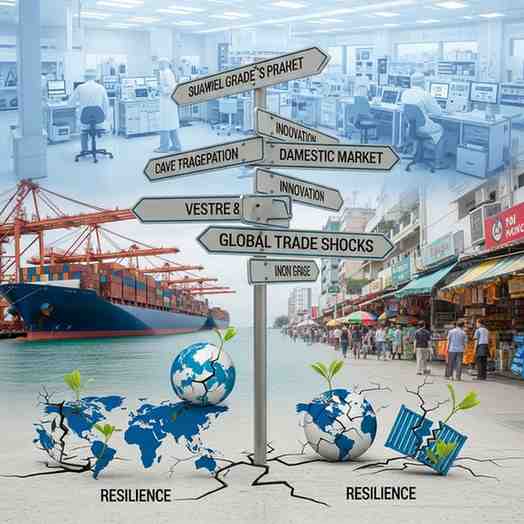
India’s Pharmaceutical Sector at a Crossroads: Resilience Amid Global Trade Shocks

India’s pharmaceutical industry, often hailed as the “pharmacy of the world”, is confronting one of its most serious external challenges in recent years. The announcement by the United States in September 2025 of a 100% tariff on branded and patented pharmaceutical imports, aimed at encouraging domestic manufacturing, has injected uncertainty into global medicine supply chains. Although generic drugs have been spared for now, the move has exposed structural vulnerabilities in India’s export-dependent pharma model and raised fundamental questions about strategic autonomy, diversification and long-term resilience.

Month: 

Category: 

India’s Space Journey in the Amrit Kaal: From Scientific Feats to National Imagination

India’s space programme has entered a transformative phase, evolving from a series of remarkable scientific achievements into a shared national experience. What was once perceived as a specialised domain of scientists and engineers has today become a powerful symbol of collective aspiration, governance capability and civilisational confidence. In the Amrit Kaal, India’s space journey is no longer only about rockets and orbits; it is about how a nation imagines its future and locates itself in the global order.

Month: 

Category: 

India’s Rice Paradox: Export Powerhouse, Groundwater Crisis

When India emerged as the world’s largest producer and exporter of rice, the achievement was celebrated as evidence of farmer resilience and effective state support. Crossing 20 million metric tonnes in exports and overtaking traditional leaders signalled not only market dominance but also geopolitical relevance, as India became the single most influential actor in global rice trade. Yet beneath this success lies a troubling paradox. In the rice heartlands of Punjab and Haryana, the very policies that ensured production stability are driving an ecological crisis that threatens the long-term sustainability of Indian agriculture.

Month: 

Category: 

Recasting Sin Taxes in the GST Era: Why the Centre’s Latest Move Matters

The Union government’s decision to restore excise duty on cigarettes and introduce a machine-capacity-based cess on pan masala marks a significant recalibration of India’s sin-tax framework. Nearly a decade after the rollout of the Goods and Services Tax (GST), this move signals an acknowledgement that the original architecture, while simplifying indirect taxation, left critical gaps in taxing demerit goods. Far from being a routine revenue measure, the reform reflects the State’s attempt to realign fiscal policy with public health, enforcement realities and the post-compensation GST landscape.

Month: 

Category: 

India as the World’s Fourth-Largest Economy: Scale Achieved, Prosperity Awaited

India’s rise to become the world’s fourth-largest economy in nominal GDP terms marks a defining moment in its post-Independence economic journey. With output estimated at around $4.18 trillion, India has overtaken Japan, placing itself behind only the United States, China and Germany. This achievement reflects decades of growth, reform and resilience, and confirms India’s growing weight in the global economic order. Yet, behind the celebration lies a deeper paradox: India’s economic scale has expanded rapidly, but average prosperity remains modest for a large share of its population.

Month: 

Category: