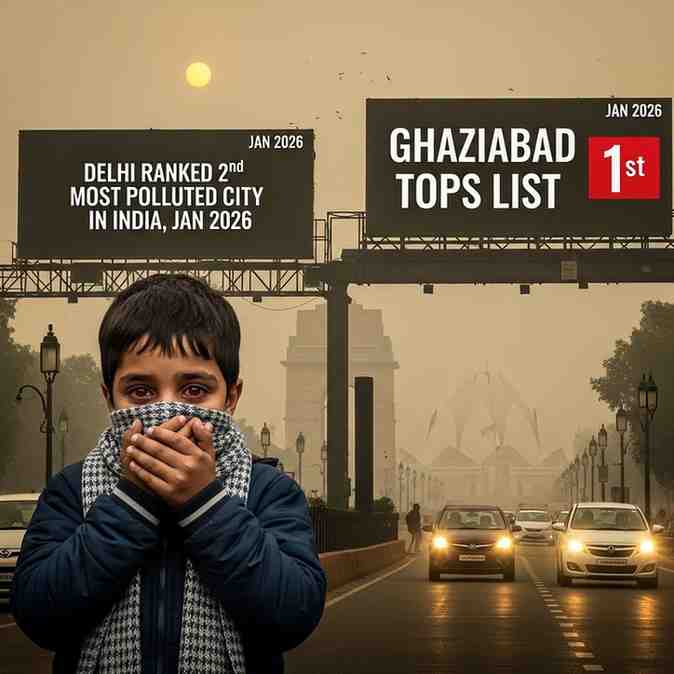
January 2026 Air Quality Crisis: Delhi and Ghaziabad Top India's Polluted Cities List
A monthly analysis for January 2026 by the Centre for Research on Energy and Clean Air (CREA) has ranked Delhi as the second most polluted city in India , with Ghaziabad topping the list . The report underscores the persistent and severe winter air pollution crisis in North India, highlighting widespread non-compliance with both national and international air quality standards.
Severe PM2.5 Levels in the National Capital Region
Delhi recorded a monthly average PM2.5 concentration of 169 micrograms per cubic metre (µg/m³) , which is nearly three times higher than India's National Ambient Air Quality Standards (NAAQS) annual limit of 60 µg/m³ . The situation was even more critical in Ghaziabad , which emerged as the country's most polluted city with an average of 184 µg/m³ , breaching the daily national standard on all 31 days of January.
Consistently Hazardous Air Quality in Delhi
According to the CREA analysis, Delhi's air quality remained dangerously poor throughout the month. The city experienced:
-
24 days classified as 'Very Poor' (AQI 301-400)
-
3 days in the 'Severe' category (AQI above 400)
-
Only 2 days with 'Moderate' air quality
This pattern indicates prolonged exposure to hazardous pollution levels for residents, posing serious public health risks.
Widespread National Non-Compliance and Policy Gaps
The report revealed a grim national picture, with 123 out of 248 monitored cities across India recording PM2.5 levels above the national standard. Critically, no city met the World Health Organization's (WHO) stringent daily safe guideline of 15 µg/m³ . The analysis pointed to significant shortcomings in the National Clean Air Programme (NCAP) , noting that air quality in most cities covered under the program remained non-compliant. CREA analysts emphasized the urgent need to refocus NCAP on directly targeting PM2.5 and its precursor gases (like SO₂ and NO₂) , adopting stricter industrial emission norms, and shifting towards an integrated airshed-based management approach for the Indo-Gangetic Plain.
Exam-Focused Important Facts:
-
Ranking: Ghaziabad (1st) and Delhi (2nd) were the most polluted Indian cities in January 2026.
-
Key Pollutant: PM2.5 (fine particulate matter).
-
Standards: India's NAAQS annual limit is 60 µg/m³ ; the WHO daily guideline is 15 µg/m³ .
-
Health Impact: PM2.5 can enter the bloodstream and affect multiple organs.
-
Government Program: National Clean Air Programme (NCAP) aims to reduce pollution in non-attainment cities.
Month: Current Affairs - February 07, 2026
Category: Environment - Ecology