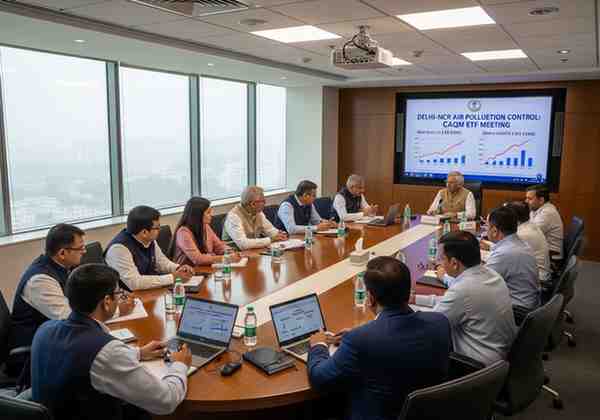
CAQM Reviews Air Pollution Controls.
Recently, the 128 th meeting of the Enforcement Task Force (ETF) of the Commission for Air Quality Management was conducted to review the current efforts in controlling air pollution in Delhi-NCR and the surrounding areas. The meeting also aimed at enhancing enforcement and coordination of states and effective implementation of pollution control measures.
Mandate and Core Objectives.
CAQM is a legal organization created by the Commission for Air Quality Management in National Capital Region and Adjoining Areas Act, 2021. Its primary goal is to tackle air pollution by means of co-ordinated planning, research, and policy execution. The commission strives to enhance the Air Quality Index (AQI) and address environmental issues in a long-term and systematic way.
Jurisdiction and Multi-State Coordination.
The commission encompasses Delhi-NCR and other neighboring states like Punjab, Haryana, Rajasthan and Uttar Pradesh. As air pollution defies boundaries, CAQM makes sure that these areas act in coordination. It oversees the level of pollution, advises states on ways to mitigate the situation and enforce compliance to environmental standards.
Authority and Coercion.
The enforcement power of CAQM is high. It is able to provide legally binding orders, limit polluting operations and carry out inspection. Both the government agencies and the private entities must abide by its decisions. The commission is further answerable to Parliament which enhances its institutional credibility and effectiveness.
Exam-Focused Points
- CAQM awarded by Act of Parliament 2021.
- Covering Delhi-NCR + other adjoining states.
- Instructions are legally binding.
- Target: Clean up and air quality.
- ETF = Enforcement Task Force of CAQM.
Structure of the Organization.
The Chairperson of the commission is a Secretary or Chief Secretary. It has the representatives of central and state governments, technical specialists, and the representatives of such organisations as the Central Pollution Control Board (CPCB), Indian Space Research Organisation, and NITI Aayog. This heterogeneous organization provides scientific, administrative and policy expertise in addressing air pollution.
Month: Current Affairs - April 05, 2026
Category: Environment - Pollution Control