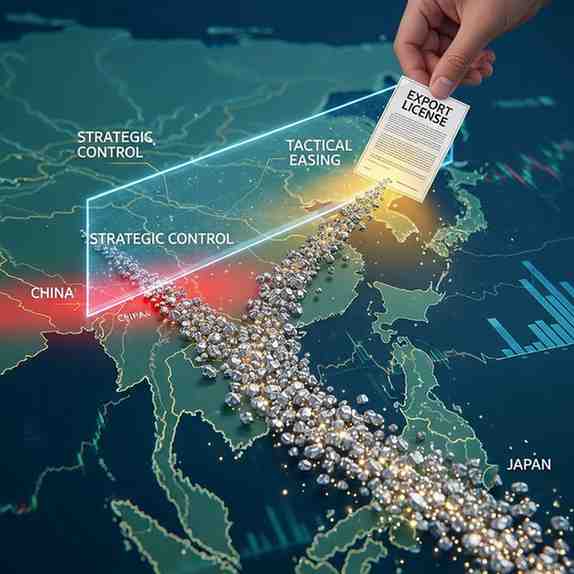
Limited Clearances Amid Tightened Controls
China has begun approving a small number of rare earth export licences to Japan under its newly enforced “dual-use” export control framework. The move offers short-term relief to Japanese manufacturers but does not amount to a broad relaxation. Industry feedback suggests approvals are selective, slower than earlier processes, and capped well below historical volumes—underscoring Beijing’s continued caution.
Chinese regulators have reiterated that materials with potential military applications remain subject to stringent scrutiny, with approvals granted only for clearly verified civilian end-use.
Dual-Use Rules and Strategic Messaging
The revised regime draws a sharper line between civilian and defence applications. Officials in China say exports tied to weapons or sensitive technologies remain prohibited, while “compliant” civilian uses may proceed via licensing.
Japan’s dependence on China—about 72% of its rare earth imports—gives Beijing leverage without resorting to a blanket embargo reminiscent of the 2010 Senkaku Islands episode. Allowing limited flows appears designed to ease market panic while preserving strategic signalling through licensing discretion.
Industry Impact and Compliance Burden
Heavy rare earths such as dysprosium and terbium face the toughest checks because of their role in high-performance magnets for electric vehicles and advanced defence systems. Japanese importers now submit detailed disclosures on downstream users and re-export destinations, increasing compliance costs and lead times.
Analysts at Nomura Research Institute estimate that prolonged delays could trigger annual production losses of about ¥2.6 trillion , equivalent to approximately ₹1.46 lakh crore , potentially shaving 0.43% off Japan’s GDP if disruptions persist.
Important Facts for Exams
-
Rare earths are essential for EVs, electronics, renewables and defence systems
-
China dominates global rare earth processing and refining
-
“Dual-use” items have both civilian and military applications
-
Japan is a major importer of rare earth materials
Diversification Drive and the Road Ahead
Supply uncertainty has accelerated Japan’s diversification push. The deep-sea drilling vessel Chikyu recently recovered rare-earth-rich mud near Minamitorishima Island—a world first—though commercial output is unlikely before 2027. Tokyo is also deepening partnerships with the US and the EU to build resilient supply chains.
For now, China’s limited approvals function as a temporary bridge, easing immediate pressure while reinforcing the reality that rare earths have become a tool of economic statecraft.
Month: Current Affairs - February 07, 2026
Category: Strategic Resources | Critical Minerals