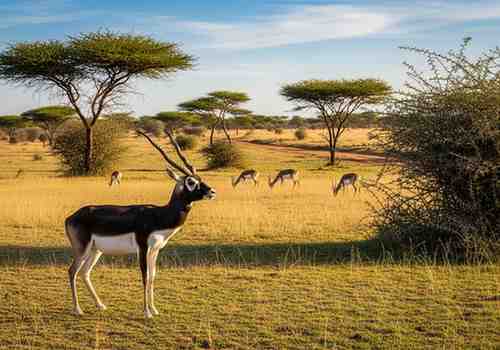
Reintroduction of blackbucks will help in conservation.
The release of the Blackbuck in the Rampur grassland of Barnawapara Wildlife Sanctuary is a significant move towards the conservation of biodiversity. This is an effort to recreate the natural grassland ecosystem and rehabilitate the population of native species, and it represents a renewed interest of India in habitat restoration.
Geographic Features and Location.
Barnawapara Wildlife Sanctuary is in the Mahasamund district of Chhattisgarh. It is named after two forest villages; Bar and Nawapara, which are located within the sanctuary. The area covers an area of approximately 245 square kilometres, and it is fed by tributaries of the Mahanadi River. The river Balamdehi provides the western boundary, and the river Jonk makes its course on the east and northeast sides, making the ecosystem richer.
Vegetation and Flora
The sanctuary is controlled by tropical dry deciduous forests. The important tree species are teak, sal, bamboo and terminalia. There are other significant plants like mahua, semal, ber and tendu which contribute to the ecological diversity. This fertile land sustains a large number of herbivores and houses wildlife.
Faunal Diversity and Ecological Function.
Various wildlife can be found in Barnawapara such as tigers, leopards, Indian bison and neelgai. It also sustains animals, such as wild boar, porcupines, python, sambhar, and cheetal. It hosts approximately 150 bird species (such as parrots, egrets and peafowl) here. The reintroduction of blackbucks is specifically significant to sustain the ecology of grasslands and reinforce the food chain.
Exam-Focused Points
- District: Mahasamund, Chhattisgarh.
- Area: ~245 sq. km
- Type of forest: Tropical dry deciduous.
- Rivers: Balamdehi & Jonk
- Important species: Blackbuck, tiger, bison.
Ecological Significance and Preservation.
The sanctuary is critical in the protection of the biodiversity of central India. Its combination of grassland and forest ecosystems sustains harmonized ecosystems. Such efforts as species reintroduction and habitat management enhance ecological sustainability and guarantee the long-term survival of wildlife populations.
Month: Current Affairs - April 07, 2026
Category: Environment - Biodiversity