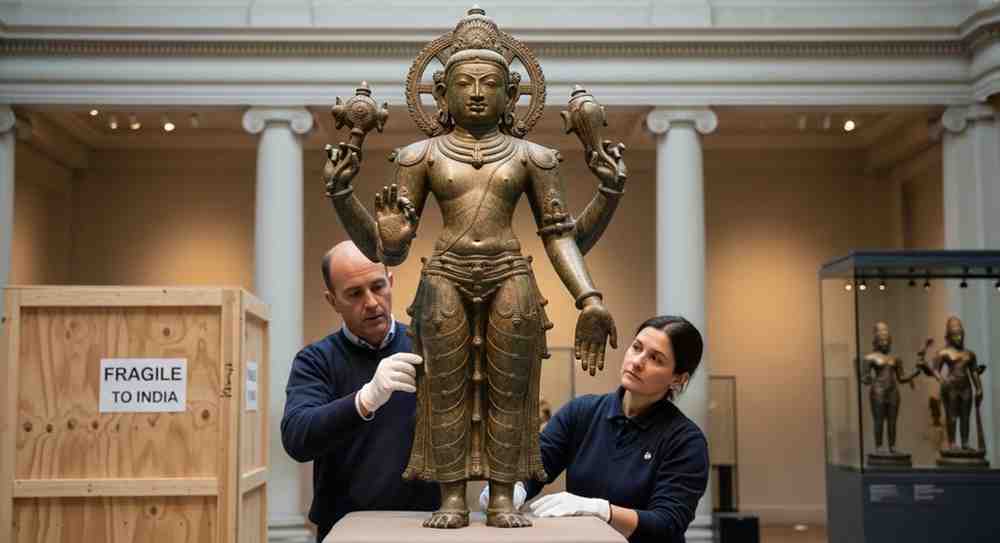
16th-Century Tamil Nadu Temple Idol Repatriated from Oxford Museum
A 16th-century bronze statue of Tirumankai Alvar is set to be returned to India by the Ashmolean Museum. The sculpture, approximately 57.5 centimetres tall, has been part of the museum’s collection since 1967. Recent research established that the statue originally belonged to a temple in Tamil Nadu, prompting the decision to repatriate the artefact. The move reflects growing international efforts to return cultural objects to their countries of origin.
Religious and Cultural Significance
The statue represents Tirumankai Alvar, one of the twelve Alvar saints revered in the Vaishnavite devotional tradition. The Alvars were poet-saints who composed hymns praising Lord Vishnu and contributed significantly to the Bhakti movement in South India.
The bronze idol originally came from the Soundararajaperumal Temple in Thadikombu village. Such bronze sculptures are traditionally used during temple rituals and processions. Crafted using classical South Indian metal-casting methods, the artefact holds both spiritual and artistic importance.
How the Artefact Reached Oxford
The Ashmolean Museum acquired the statue in 1967 from a private collector, Dr. J. R. Belmont. At the time, the museum believed the purchase to be legitimate, although the earlier ownership history of the sculpture remained unclear.
In 2019, a researcher discovered a photograph taken in 1957 that showed the same statue inside the Soundararajaperumal Temple. This discovery raised questions about the artefact’s provenance and prompted further investigation by the museum.
Provenance Investigation and India’s Claim
Following the discovery, the Ashmolean Museum contacted the Indian High Commission in 2019 to discuss the matter. In February 2020, temple authorities filed a police complaint stating that the original bronze idol had been replaced with a replica.
At the request of the Archaeological Survey of India (ASI), scientific analysis of the metal composition was conducted. The results supported evidence linking the sculpture to the Tamil Nadu temple, strengthening India’s claim for its return.
Important Facts for Exams
-
Tirumankai Alvar is one of the twelve Alvar saints of the Vaishnavite Bhakti tradition.
-
The Alvars composed devotional hymns known collectively as the Divya Prabandham .
-
The Ashmolean Museum in Oxford was founded in 1683 and is one of the oldest public museums.
-
The Archaeological Survey of India oversees the protection of India’s archaeological heritage.
Global Trend of Cultural Repatriation
The return of the Tirumankai Alvar statue reflects a broader global movement toward reassessing the ownership of cultural artefacts. Museums and cultural institutions are increasingly reviewing the provenance of objects in their collections to ensure they were acquired ethically.
This repatriation represents cooperation between scholars, museums and government authorities and restores an important heritage object to its original religious and cultural setting in India.
Month: Current Affairs - March 05, 2026
Category: Culture | Heritage