Overview
The Artemis II mission of NASA has been able to successfully complete the mission, the first crewed flyby of the moon in more than 50 years since the Apollo period. The almost 10-day mission is a significant milestone in human space exploration and is a key step towards future lunar landings and deep space missions.
Historic Splashdown
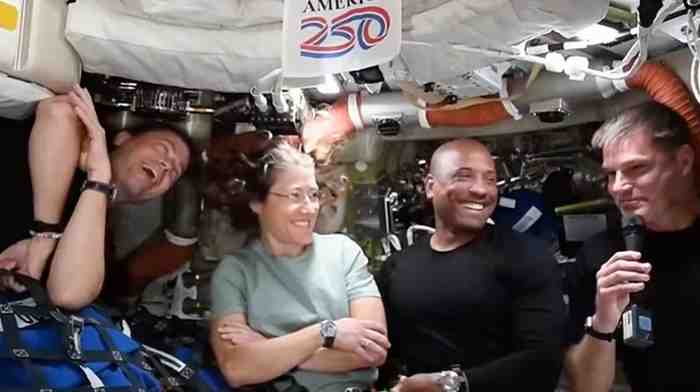
The Orion spacecraft was called Integrity and landed safely in the Pacific Ocean off San Diego. The crew of Reid Wiseman, Victor Glover, Christina Koch and Jeremy Hansen performed a speedy re-entry, reaching Mach 33 at one point. The landing was performed in automated mode, which guaranteed accuracy and safety.
Re-entry Challenges
The spacecraft was exposed to high temperatures of friction as it entered the atmosphere, which is caused by friction between it and the atmosphere of the earth. This generated a plasma layer surrounding the capsule, and caused a momentary communication blackout between the mission control and the capsule. This type of blackout is an anticipated and normal part of high-speed re-entry.
Landing and Descent Sequence.
The process of landing was planned and carried out properly. Drogue parachutes were used to stabilise the spacecraft and slow down by deploying them at approximately 23,400 feet. This was succeeded by the launching of three primary parachutes at about 5,400 feet enabling a controlled landing of the splashdown to less than 200 feet per second.
Mission Significance and Recovery.
Upon arrival, recovery teams retrieved the capsule and safely took the astronauts. They were flown in the USS John P. Murtha where they received primary medical examinations before transferring to NASA Johnson Space Center. The Artemis II mission is an important milestone in NASA long term Artemis programme, which will lead to future landings on the Moon and even the human missions to Mars.
Exam-Focused Key Points
- Artemis II is the first NASA crews mission in 50 years since Apollo landing.
- Orion spacecraft is made to make deep space human missions.
- Re-entry blackout is caused by the formation of plasma.
- Mach speed depicts the multiples of the speed of sound.
- Mission helps in future Moon and Mars exploration.
Practice Questions (with answers)
Q1. Why is Artemis II mission important?
Response: The first lunar flyby crewed since the Apollo era.
Q2. Whose spacecraft was Artemis II?
Answer: Orion spacecraft.
Q3. Why should there be communication blackout during re-entry?
Reason: Radio is blocked by ionised plasma.
Q4. Where did Artemis II splash down?
Response: Pacific Ocean off San Diego.
Q5. What is the general aim of the Artemis programme?
Response: Re-entry to the Moon and future missions to Mars.
Month: Current Affairs - April 11, 2026
Category: Space Technology