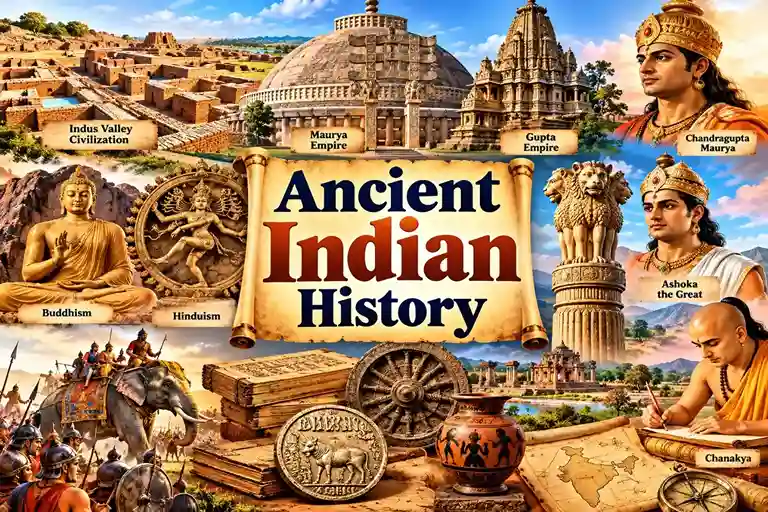
Overview :
Study Ancient Indian History in very simple English. Get complete notes on historical sources, Stone Age, Harappan Civilization, Vedic Age, Buddhism, Jainism, Maurya, Gupta, art, literature and science.
1. Sources of Indian History
Indian history is mainly studied through two broad types of sources:
- Archaeological Sources
- Literary Sources
These sources help us understand the life of people in different periods.
Archaeological Sources
Archaeological sources are found through excavation and physical remains.
Important archaeological sources include:
- Inscriptions
- Pottery
- Coins
- Temples
- Buildings
- Monuments
- Tools
- Sculptures
- Seals
- Burial sites
- Other objects found during excavation
Inscriptions
- Inscriptions are writings found on stone, metal or other materials.
- They give information about rulers and their activities.
- They can also give information about religion, administration and society.
- Ashokan inscriptions are important sources for Mauryan history.
Coins
- Coins are important sources of economic history.
- They also give information about rulers.
- Coins can show names, titles, symbols and religious ideas.
- The study of coins is called Numismatics .
- In Hindi, it is called Mudra Shastra .
- The source mentions the Numismatic Society of India at Allahabad.
Pottery
- Pottery helps us understand ancient settlements.
- Different periods had different types of pottery.
- Pottery can help archaeologists identify cultural changes.
Monuments and Temples
- Buildings give information about architecture.
- Temples help us understand religion and art.
- Forts and other structures also provide historical evidence.
2. Literary Sources
Literary sources are written records.
They include:
- Religious texts
- Non-religious texts
- Historical works
- Travel accounts
- Biographies
- Administrative records
Religious Literary Sources
The source divides religious texts into:
- Brahmanical texts
- Non-Brahmanical texts
Brahmanical Texts
Important texts include:
- Vedas
- Puranas
- Upanishads
- Aranyakas
- Brahmanas
Non-Brahmanical Texts
Important sources include:
- Buddhist literature
- Jain literature
These texts help us understand religion, society and ideas of ancient India.
3. Puranas
The source highlights the Puranas as an important historical source.
Important facts:
- The Puranas contain information about kings and dynasties.
- They can help in understanding the order of rulers.
- There are traditionally 18 Puranas .
- The source links their composition with Lom Harsh and Ugra Shrava .
- Matsya Purana is presented in the source as the oldest Purana.
- Matsya Purana gives information about the Shunga and Satavahana dynasties .
- Vishnu Purana gives information about the Maurya dynasty .
- Vayu Purana gives information about the Gupta dynasty .
4. Bogazkoi Inscription
- The Bogazkoi inscription is an important ancient inscription.
- It was found in Central Asia.
- The source places it around 1400 BCE .
- It mentions several Vedic gods.
- The names mentioned include Indra, Mitra, Varuna and Nasatya .
- The source stresses that Agni is not mentioned in this inscription.
- It is an important source for questions about early Indo-Iranian religious links.
5. Ancient Indian Architecture
Ancient Indian temples show different styles.
The source discusses:
- Nagar style
- Dravida style
- Vesara style
- Panchayatana style
Panchayatana Style
- The main temple stands in the centre.
- Four smaller temples are placed around it.
- Thus, the arrangement has five temples.
- This is called the Panchayatana style .
- The Dashavatara Temple at Deogarh is discussed in the source in this context.
Nagar Style
- It is mainly linked with North Indian temples.
- The temple tower rises upward.
- The upper part has a curved or dome-like form.
Dravida Style
- It is mainly linked with South Indian temples.
- The structure becomes narrower as it rises.
- The top is generally flat in the basic description given in the source.
Vesara Style
- It combines features of Nagar and Dravida styles.
- It is often described as a mixed temple style.
6. Buddhist Literature
The main collection of Buddhist literature is called Tripitaka .
It has three main parts:
- Sutta Pitaka
- Vinaya Pitaka
- Abhidhamma Pitaka
Sutta Pitaka
- It contains the teachings of Gautama Buddha.
- The source connects its compilation with Ananda.
Vinaya Pitaka
- It deals with the rules of Buddhist monks.
- It explains how monks should live.
- The source connects it with Upali.
Abhidhamma Pitaka
- It deals with Buddhist philosophical ideas.
- The source connects it with Moggaliputta Tissa.
- It was linked with the period of Ashoka.
- It is connected with the Third Buddhist Council .
7. Upanishads
- Upanishads are important Vedic texts.
- They are called Vedanta .
- Vedanta means the end
Month: Current Affairs - Sep 28, 2026
Category: History