Renewed Scientific Attention on a Dormant but Active Volcano
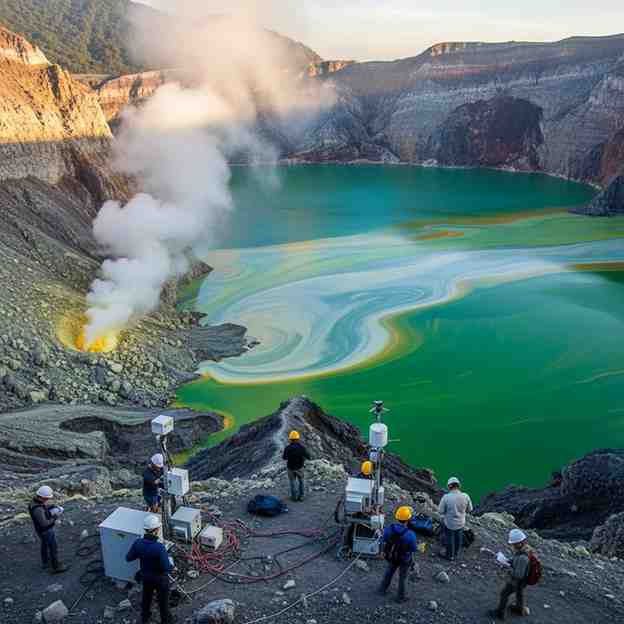
Unusual physical and chemical changes inside the crater of El Chichón volcano in southern Mexico have prompted renewed concern among scientists. Researchers studying the crater lake report that while no immediate eruption is expected , the volcano has entered a phase of geochemical instability , indicating an increasingly dynamic hydrothermal system beneath the surface.
Rising Temperatures and Intensifying Gas Release
Monitoring teams observed a series of anomalies between June and December 2025 . Surface temperatures in the crater lake repeatedly surged to around 118°C , far exceeding normal geothermal values.
In addition, visible gas bubbling was recorded across multiple points in the lake. Measurements showed elevated emissions of hydrogen sulfide (H₂S) and carbon dioxide (CO₂) —gases typically associated with hydrothermal circulation but potentially hazardous when trapped in confined volcanic basins.
Sulfur Spheres and Shifting Lake Chemistry
Scientists from the National Autonomous University of Mexico documented the appearance of floating hollow sulfur spheres , a rare phenomenon formed when volcanic gases pass through pools of molten sulfur beneath the lakebed and rapidly cool.
The lake’s colour has also changed dramatically—from an algae-rich green to a greyish tone , signalling higher concentrations of sulfates and silica . Large fluctuations in chloride levels further suggest changes in subsurface fluid pathways and heat transfer mechanisms.
Lessons from the 1982 Catastrophic Eruption
Current observations are being interpreted in the context of El Chichón’s 1982 eruption , one of the most destructive volcanic events in Mexico’s modern history. That eruption killed more than 2,000 people , buried nearby villages under ash and pyroclastic material, and released vast quantities of sulphur dioxide into the stratosphere—causing a short-term global cooling effect .
The eruption also reshaped the volcano’s summit, forming the crater lake that now acts as a sensitive indicator of internal volcanic processes.
Alert Status and Monitoring Challenges
El Chichón remains under a yellow alert (phase two) , denoting abnormal activity without signs of imminent eruption. However, experts caution that monitoring gaps , especially in continuous seismic, gas, and thermal data, limit accurate forecasting.
Institutions such as CENAPRED are now expanding surveillance using drones, satellite data, and remote sensing tools . Scientists emphasise that although magma ascent appears unlikely, phreatic (steam-driven) explosions —which can occur suddenly without magma movement—remain a realistic risk.
Exam-Focused Key Points
-
El Chichón is located in Chiapas, southern Mexico
-
The 1982 eruption caused mass casualties and global climatic impact
-
Hydrothermal activity involves hot water and gases, not rising magma
-
Phreatic eruptions are steam-driven and highly unpredictable
-
Crater lakes act as early indicators
Month: Current Affairs - February 06, 2026
Category: Disaster Management | Volcanology