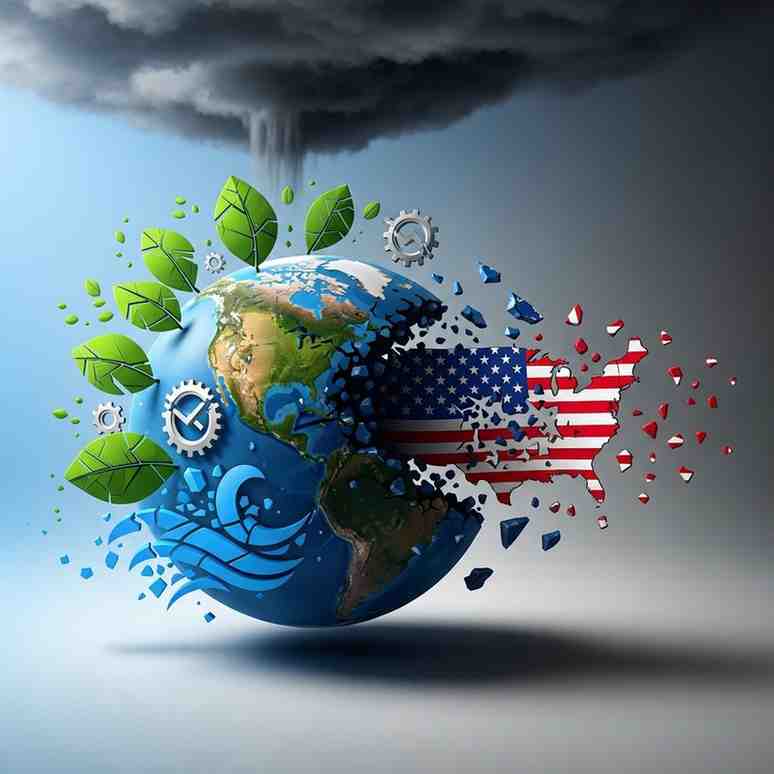
The decision of the United States under President Donald Trump to withdraw not only from the Paris Agreement but also from the foundational institutions of global climate governance marks an unprecedented rupture in international cooperation. By formally exiting the United Nations Framework Convention on Climate Change (UNFCCC) and the Intergovernmental Panel on Climate Change (IPCC), Washington has stepped away from the core legal and scientific architecture that underpins collective climate action. This move goes far beyond policy disagreement; it challenges the very logic of multilateralism in addressing a global commons problem.
Why the UNFCCC matters
The UNFCCC is the parent treaty of global climate diplomacy. It provides the legal framework under which climate negotiations take place, including annual Conferences of the Parties (COPs), reporting and transparency mechanisms, carbon market rules, and climate finance arrangements. The Paris Agreement is not a standalone pact but a protocol nested within this framework. Withdrawal from the UNFCCC therefore automatically entails withdrawal from all its protocols, leaving the US outside the system that defines obligations, norms and accountability.
Almost every country in the world remains a party to the UNFCCC. The US will now be the first to formally abandon it, reducing its status at climate negotiations to that of an observer with no legal standing to negotiate or influence outcomes. For a country that once shaped climate rules from within, this represents a sharp retreat from rule-making to rule-avoidance.
The emissions reality
The consequences of this exit are magnified by the United States’ role in the climate problem itself. According to the Global Carbon Project , US carbon dioxide emissions in 2024 were close to 4.9 billion tonnes, accounting for about 12–13% of global emissions. On a per-capita basis, US emissions remain among the highest in the world. Historically, the US is the largest cumulative emitter of greenhouse gases, responsible for roughly a quarter of all emissions since the industrial era.
Given this record, withdrawal from the global climate framework raises serious questions of equity and responsibility. Climate change is a stock problem, driven by accumulated emissions over time. When a major historical contributor exits the system designed to manage this shared risk, it weakens the moral and political foundations of collective action.
Climate finance and trust deficits
One of the most immediate impacts is likely to be felt in climate finance. The UNFCCC oversees a financial mechanism that includes institutions such as the Green Climate Fund and the Global Environment Facility. As a non-party, the US will no longer participate in shaping these mechanisms and may find it politically easier to withhold contributions altogether.
For developing countries, this deepens an already fragile trust deficit. Although developed countries collectively crossed the $100 billion annual climate finance target in 2022, adaptation finance remains severely inadequate. Estimates suggest that developing countries will require several hundred billion dollars annually by the 2030s to adapt to climate impacts. When a wealthy, high-emitting country steps away from the system, it hardens negotiating positions and reinforces perceptions that climate commitments are unevenly honoured.
Stepping away from climate science
The US exit from the IPCC has equally serious implications. The IPCC does not prescribe policy; it synthesises global scientific research on climate change, impacts and response options. Its assessments form the evidentiary backbone of climate negotiations and national policymaking worldwide.
While American scientists may still contribute informally, government membership matters in practice. It shapes nominations, coordination and influence over assessment priorities. Reduced US engagement risks weakening the global scientific consensus-building process and signals political scepticism towards climate science itself, at a time when evidence of climate impacts is becoming increasingly stark.
Systemic global repercussions
At a systemic level, the US withdrawal undermines the reciprocity on which multilateral climate action depends. Climate governance relies less on enforcement and more on shared expectations and peer pressure. When a major power exits, it creates incentives for others to delay action, dilute commitments or seek exemptions.
There is also a risk of fragmentation. As universal forums weaken, climate action may increasingly shift towards smaller coalitions, bilateral deals and trade-linked instruments such as carbon border adjustment mechanisms. While these may generate pressure in some sectors, they also risk creating uneven standards, trade disputes and uncertainty for global markets.
For vulnerable countries, the costs are potentially severe: slower mitigation, weaker adaptation support and delayed progress on loss and damage, precisely when climate risks are intensifying.
Conclusion
The US decision to withdraw from both the UNFCCC and the IPCC represents a retreat not just from specific agreements, but from the multilateral logic of managing a shared planetary crisis. While global climate action will continue without Washington, its absence from the rule-making table weakens trust, coherence and ambition. In the long run, climate change will not be contained by unilateralism. The episode serves as a stark reminder that effective climate governance depends not only on national policies, but on sustained commitment to global institutions capable of coordinating collective responsibility.
Month: Current Affairs - Jan 13, 2026
Category: