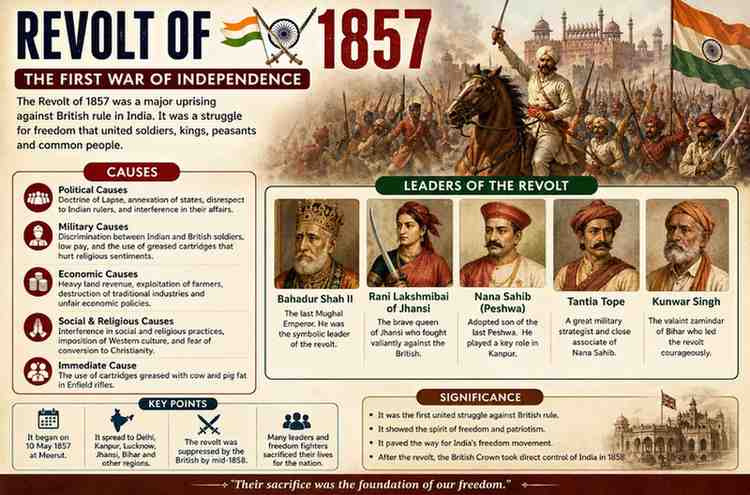
Exam-Focused Points :
-
Start Date and Place: The revolt began on May 10, 1857, at Meerut, starting as a sepoy mutiny.
-
Doctrine of Lapse: Governor-General Dalhousie introduced this policy, annexing states like Satara, Jhansi, and Nagpur. Awadh was annexed in 1856.
-
Greased Cartridges: The Enfield rifle cartridges allegedly used cow and pig fat. This offended Hindu and Muslim sepoys, sparking the revolt.
-
Key Leaders: Rani Lakshmibai (Jhansi), Nana Saheb (Kanpur), Begum Hazrat Mahal (Lucknow), Kunwar Singh (Bihar), and Bahadur Shah Zafar (Delhi).
-
End of Company Rule: The Government of India Act, 1858, transferred Indian administration from the East India Company to the British Crown.
-
First Viceroy: Lord Canning became the first Viceroy of India after the Act of 1858.
-
Significance: Though suppressed, the revolt inspired future nationalists and is called India's First War of Independence by V.D. Savarkar.
FAQs :
Q1: Who called the Revolt of 1857 the First War of Independence?
V.D. Savarkar used this term in his book The Indian War of Independence .
Q2: What was the immediate cause of the 1857 revolt?
The greased cartridges for the Enfield rifle. Soldiers had to bite them, and rumours spread that they contained cow and pig fat.
Q3: Why did the Revolt of 1857 fail?
It lacked unified leadership, remained geographically limited, faced British military superiority, and many princely states supported the British.
Q4: What was the Doctrine of Lapse?
A policy by Governor-General Dalhousie that annexed states where rulers died without a male heir, including Jhansi and Nagpur.
Q5: What was the result of the 1857 revolt?
The East India Company's rule ended. The Government of India Act, 1858, placed India under the British Crown.
Month: Current Affairs - Aug 10, 2026
Category: Revolt of 1857