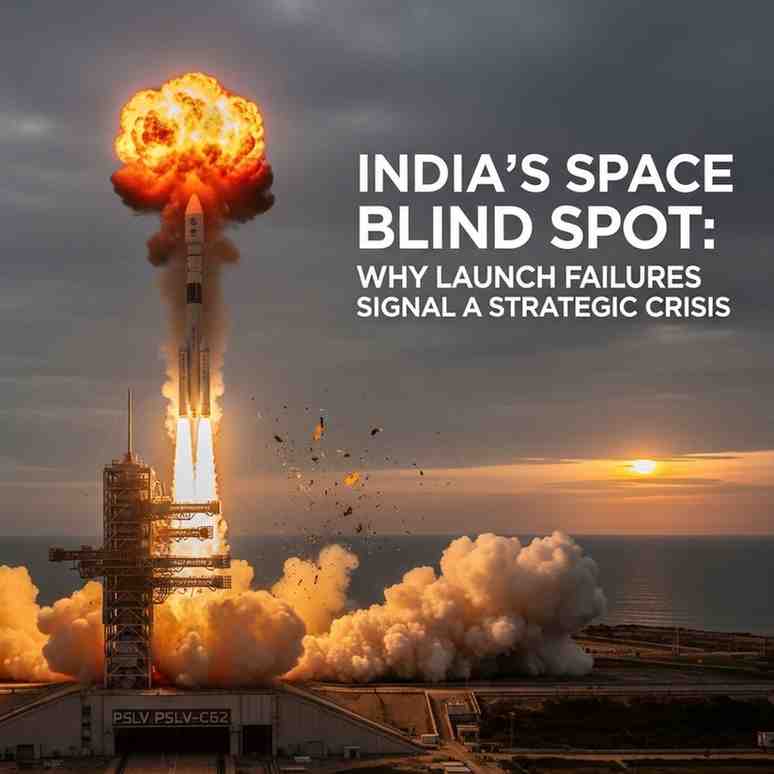
PSLV-C62 and India’s Strategic Space Deficit
The failure of the PSLV-C62 mission is not merely a technical setback for the Indian Space Research Organisation (ISRO). It is a warning about deeper structural weaknesses in India’s space ecosystem at a moment when space has become central to economic competitiveness, military effectiveness, and strategic autonomy. As space increasingly underpins outcomes across land, sea, air, cyber and information domains, India’s relative slippage carries consequences far beyond prestige.
Beyond launch failures: a systemic concern
This is the fifth ISRO failure in seven years. While launch mishaps occur even in mature programmes, the real concern lies elsewhere: stagnation across the space value chain. Despite being the world’s fourth-largest economy, India is losing ground to established space powers—the United States, China, Russia, the European Union and Japan—across upstream (satellite constellations), midstream (data processing), and downstream (commercial services) segments. The issue is not episodic failure but systemic underperformance.
Prestige missions versus depth and scale
India’s prioritisation of prestige programmes has come at a cost. In 2017, India commanded an estimated 35% of the global small satellite launch market. By 2024, that share had effectively dropped to zero. Reliability concerns, limited launch frequency, and constrained infrastructure have eroded competitiveness. Satellite production timelines have stretched, and India is rapidly running out of suitable orbital slots—worsened by delays in filings with the International Telecommunication Union, even as American and Chinese entities lock in spectrum and orbits at scale.
Navigation autonomy under strain
India’s navigation experience illustrates the limits of self-reliance. After GPS restrictions during Kargil, India built NavIC . Yet today, only four NavIC satellites are fully functional, two nearing end-of-life—below the minimum viable constellation. By contrast, China’s Beidou has matured into a robust global network, while foreign platforms continue to dominate navigation use in India.
China’s advance and regional entrenchment
China’s reforms have translated into rapid strategic expansion. In 2025 alone, China launched multiple satellites for Pakistan and secured major contracts that embed Chinese space infrastructure across South Asia. These moves create long-term dependencies and are not merely commercial. The region has become a testbed for Beijing’s space diplomacy and strategic influence.
Data sovereignty and military vulnerability
Recent crises exposed India’s reliance on foreign satellite constellations for imagery and intelligence—often with delays and constraints. China, by contrast, operates hundreds of remote sensing and electronic intelligence satellites, enabling persistent surveillance and data fusion. India’s electronic intelligence capability remains embryonic, and plans for formation-flying constellations have stalled due to funding gaps and the absence of a clear roadmap.
Institutional gaps in military space power
Unlike major powers with dedicated military space forces, India’s Defence Space Agency (raised in 2019) remains underpowered, lower-ranked, and short on specialist capacity. Fragmented data silos across services prevent a unified, real-time operating picture. Even Pakistan has moved faster to integrate space with cyber operations.
The scale of asymmetry
China’s defence budget may be roughly three times India’s, but the space asymmetry is far greater. While China operates hundreds of relevant satellites, India’s Space-Based Surveillance plans remain modest and behind schedule. As China increasingly supports Pakistan’s space capabilities, this imbalance risks translating into direct operational disadvantage.
Month: Current Affairs - January 18, 2026
Category: