OVERVIEW
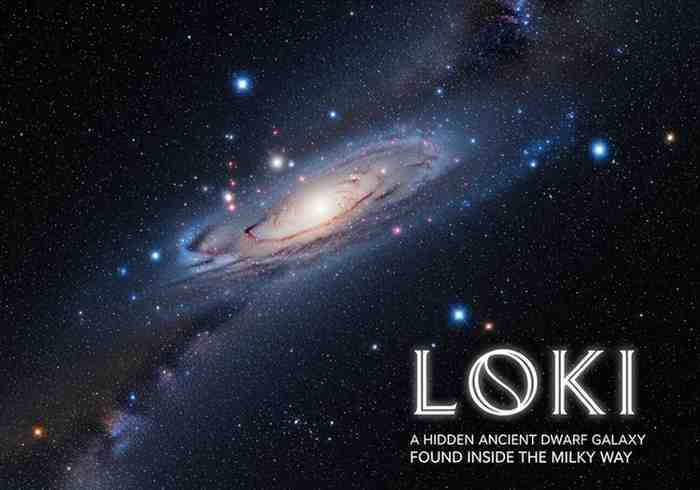
Scientists have found clues of an ancient dwarf galaxy hiding inside our own Milky Way. They have named it Loki. The study came out in May 2026 in a well-known science journal. Researchers looked at 20 very old stars near the Sun. These stars have unusual chemical fingerprints and mixed orbital paths. The finding suggests that Loki merged with the Milky Way long ago. If confirmed, Loki will join other swallowed galaxies like Gaia-Enceladus and Kraken.
WHAT IS LOKI?
Loki is the proposed name for a hidden ancient dwarf galaxy. A dwarf galaxy is a small galaxy. It has far fewer stars and less mass than a big galaxy like the Milky Way. The study was published in the Monthly Notices of the Royal Astronomical Society in May 2026. The scientists based their finding on chemical and orbital data from 20 metal-poor stars . These stars are located within 2 kiloparsecs of the Sun. (One kiloparsec is about 3,260 light-years.)
DWARF GALAXIES AND GALACTIC EVOLUTION
Dwarf galaxies often get swallowed by larger galaxies. This happens during a process called hierarchical galaxy formation . In simple words, big galaxies grow by eating smaller ones. The Milky Way has already absorbed several dwarf galaxies in the past. Some well-known examples are:
-
Gaia-Enceladus
-
Sequoia
-
Thamnos
-
Kraken
Scientists study the leftovers of these mergers by looking at:
-
Stellar chemistry (what stars are made of)
-
Orbital motion (how stars move)
-
Stellar ages (how old the stars are)
CHEMICAL AND ORBITAL EVIDENCE
The 20 stars linked to Loki gave scientists two strong clues.
Orbital clue: The stars move in mixed directions.
This mix is a sign that these stars did not form inside the Milky Way. They likely came from a different galaxy that was torn apart.
Chemical clue: The stars show chemical traces from supernovae and neutron star mergers. Neutron star mergers are known to create heavy elements like gold and platinum. Also, these stars lack signs of white dwarf activity . In stellar archaeology, this helps scientists guess that the original system lived for a short time.
OBSERVATIONAL METHOD AND SPECTROSCOPY
The team used a powerful instrument called ESPaDOnS to study the stars. ESPaDOnS is a high-resolution spectropolarimeter. It gave them high-quality spectra. Spectroscopy is a method of studying light from stars. It tells us about a star’s:
Month: Current Affairs - May 12, 2026
Category: MilkyWay