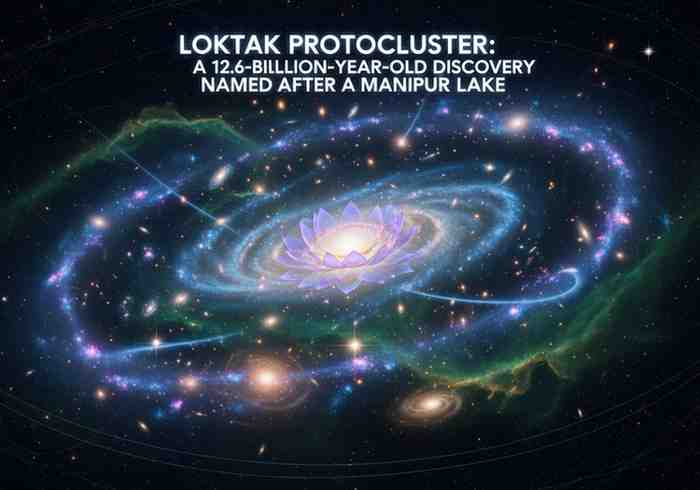
four connected concentrations of galaxies, compared to floating
phumdis of Loktak Lake.
Phumdis – floating masses of vegetation, soil, and organic matter.
Discovery tools – Subaru Telescope (Hawaii) and James Webb Space Telescope (launched 2021).
Published in – The Astrophysical Journal Letters .
Ronaldo Laishram – researcher at National Astronomical Observatory of Japan (NAOJ) .
What is a protocluster? – early-stage concentration of galaxies that later develops into a galaxy cluster (largest gravitationally bound structures in the universe).
Universe age – about 13.8 billion years .
Significance – provides data on galaxy formation in the early universe; shows environmental effects on galaxy evolution (gravity, gas supply, interactions).
FAQ (Frequently Asked Questions)
Q1: Who discovered the Loktak Protocluster?
A: The Loktak Protocluster was discovered by an international team led by Ronaldo Laishram, a Manipuri astrophysicist working at the National Astronomical Observatory of Japan.
Q2: Why is it called the Loktak Protocluster?
A: It is named after Loktak Lake in Manipur. The structure has four connected galaxy concentrations, similar to the floating phumdis of Loktak Lake that are connected to each other.
Q3: How old is the Loktak Protocluster?
A: The Loktak Protocluster is 12.6 billion years old. It existed when the universe was only about 1.2 billion years old.
Q4: What telescopes were used for this discovery?
A: The discovery used observations from the Subaru Telescope in Hawaii and the James Webb Space Telescope.
Q5: What is a protocluster?
A: A protocluster is an early-stage grouping of galaxies that later grows into a galaxy cluster. Galaxy clusters are among the largest structures in the universe and can contain hundreds or thousands of galaxies.
Month: Current Affairs - May 27, 2026
Category: Astrophysics, Indian Achievers