not always reliable
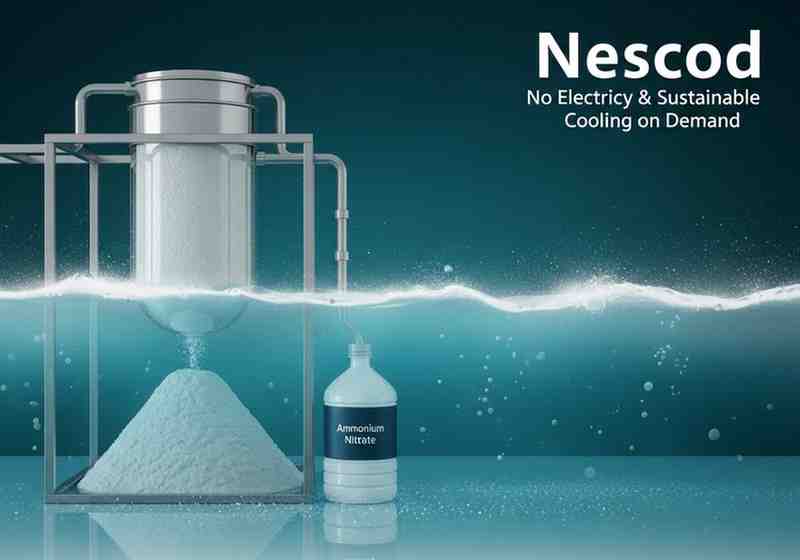
Nescod solves both problems. It does not need power from the grid. It can be used in villages, farms, or remote areas. It can help store food, cool medicines, or provide comfort in homes.
OTHER COOLING RESEARCH AT KAUST
KAUST scientists are doing great work in cooling without electricity. Here are two more examples:
1. Passive radiative cooling method: Led by Professor Qiaoqiang Gan. This method cools overheating solar panels. It also collects water from the air. It uses zero electricity. It works by sending heat out to the sky as radiation.
2. Low-cost passive cooling material: Another team made a material from sodium polyacrylate and lithium chloride. The material absorbs moisture from the air at night. During the day, it releases that moisture to cool solar panels. Again, no electricity needed.
FAQ (FREQUENTLY ASKED QUESTIONS)
Q1: What does Nescod stand for?
A: No Electricity and Sustainable Cooling on Demand.
Q2: Which university developed the Nescod cooling system?
A: King Abdullah University of Science and Technology (KAUST) in Saudi Arabia.
Q3: What is the chemical formula of ammonium nitrate?
A: NH₄NO₃.
Q4: How much did the temperature drop during testing of Nescod?
A: From about 25°C to nearly 3.6°C in around 20 minutes.
Q5: What is endothermic dissolution?
A: A process in which a substance absorbs heat while dissolving in a liquid, causing the surroundings to cool down.
EXAM-FOCUSED POINTS
-
Name of system: Nescod (No Electricity and Sustainable Cooling on Demand)
-
Developed by: KAUST (King Abdullah University of Science and Technology), Saudi Arabia
-
Working principle: Endothermic dissolution – heat absorbed when salt dissolves in water
-
Chemicals used: Ammonium nitrate (NH₄NO₃) and water
-
Salt properties: Inexpensive, readily available, easy to store
-
Test result: 25°C → 3.6°C in ~20 minutes
-
Efficiency: Four times better than ammonium chloride
-
Energy source for salt regeneration: Solar energy
-
No use of: Compressors or continuous electrical power
-
Other KAUST cooling research: Passive radiative cooling (Professor Qiaoqiang Gan); low-cost material from sodium polyacrylate and lithium chloride
-
Passive cooling definition: Operates without compressors, motors, or continuous electrical input
Month: Current Affairs - May 12, 2026
Category: Nescod-KAUST