Overview
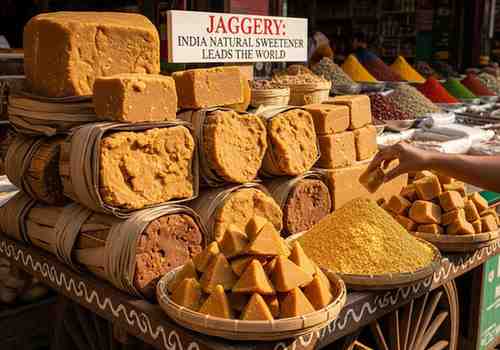
India makes more than 70% of the world’s jaggery. This makes India the global leader in natural sweeteners. Jaggery, also called gur, is an unrefined sweetener made from sugarcane juice. It keeps many healthy minerals that white sugar loses. Uttar Pradesh is the largest producer in India. Some jaggery varieties even have a GI tag, like Kolhapur Jaggery and Muzaffarnagar Gur.
What is Jaggery?
Jaggery is a traditional sweetener. People have used it for centuries. It is made by boiling sugarcane juice until it becomes solid. No chemicals are used in the process. This is why it is called unrefined and natural. Jaggery is popular in Asia, Africa, Latin America, and the Caribbean.
Minerals and Vitamins in Jaggery
White sugar has almost no nutrients. But jaggery is different. It keeps many important minerals. These include:
-
Calcium
-
Magnesium
-
Potassium
-
Phosphorus
-
Sodium
-
Iron
-
Zinc
-
Copper
-
Manganese
Jaggery also has small amounts of vitamins. These include folic acid, B‑complex vitamins, and vitamins A, C, D, and E. This makes jaggery a healthier choice than white sugar.
Production in India
India is the world’s largest jaggery producer. It accounts for over 70% of global production. Within India, three states lead the way:
| State |
Share of Production |
| Uttar Pradesh |
48.5% |
| Maharashtra |
24.1% |
| Karnataka |
10.5% |
These three states together produce most of India’s jaggery.
Health Benefits of Jaggery
Eating jaggery in moderation has many benefits. Here are some:
-
It gives sustained energy (not a quick spike like sugar).
-
It helps fight anemia because it contains iron.
-
It supports the immune system due to mineral salts and micronutrients.
-
It helps digestion when eaten after meals.
GI Tagged Jaggery Varieties in India
Some jaggery types are very special. They have a
Month: Current Affairs - May 20, 2026
Category: GITagged