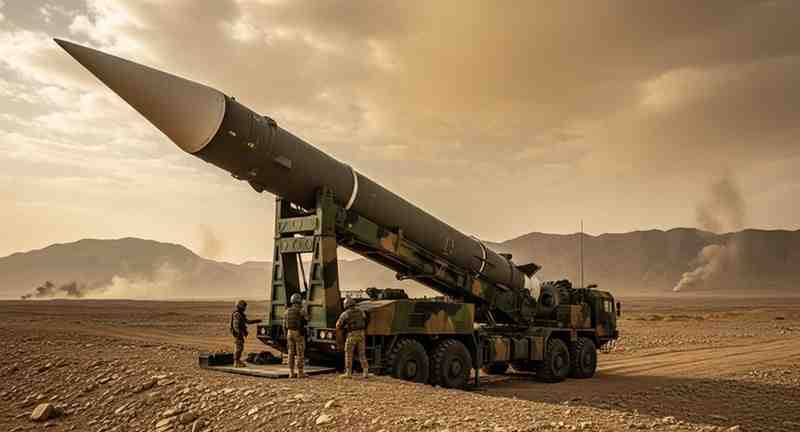
Sejjil Missile: Iran’s Long-Range Solid-Fuel Ballistic Weapon Explained
Iran has reportedly deployed the Sejjil ballistic missile for the first time during the ongoing tensions in West Asia . The missile launch was carried out as part of Operation True Promise 4 , targeting strategic sites in Israel . The development represents a notable escalation in regional hostilities because the Sejjil is considered one of Iran’s most advanced long-range missile systems.
Overview of the Sejjil Missile
The Sejjil ballistic missile , also known as Ashoura , is a two-stage surface-to-surface ballistic missile designed and manufactured domestically by Iran . Unlike earlier missile systems that relied on liquid fuel, the Sejjil uses solid-fuel propulsion , which allows for faster launch preparation and improved operational mobility.
The missile programme was developed by the Aerospace Industries Organisation , operating under Iran’s defence establishment. It was designed to gradually replace older Shahab missile series that had been in service since the late twentieth century.
Range and Technical Capabilities
The Sejjil missile has an estimated operational range of about 2,000 kilometres , enabling it to strike targets across large parts of the Middle East. The missile is approximately 18 metres long , with a diameter of about 1.25 metres and a launch weight close to 23,600 kilograms .
It can carry a warhead weighing roughly 700 kilograms , capable of delivering conventional explosive payloads. Analysts note that if launched from central Iran, the missile could theoretically reach major Israeli cities such as Tel Aviv within minutes.
Why It Is Called the “Dancing Missile”
The Sejjil is sometimes referred to as the “Dancing Missile” due to its ability to manoeuvre during different phases of flight. Such manoeuvrability allows the missile to alter its trajectory, which can complicate interception by missile defence systems.
Some reports suggest that advanced variants may incorporate features such as improved guidance mechanisms and radar-reducing materials that could help evade detection during flight.
Development and Variants
Iran carried out the first successful test of the Sejjil ballistic missile in 2008 , during which the missile reportedly travelled about 800 kilometres . Subsequent trials introduced an upgraded model known as Sejjil-2 , which demonstrated improved performance and reliability.
Speculation has also emerged about a possible Sejjil-3 version featuring a three-stage design and a potential range of up to 4,000 kilometres , although official confirmation remains limited. The exact variant reportedly used in the latest conflict has not yet been publicly verified.
Exam-Focused Points
-
Sejjil ballistic missile is a two-stage, solid-fuel ballistic missile developed by Iran .
-
The missile has an estimated range of about 2,000 km .
-
It can carry a warhead of approximately 700 kg .
Month: Current Affairs - March 16, 2026
Category: