resilience in the face of natural and man-made disruptions. Space, in this sense, is not removed from development; it is embedded within it.
Opening space to private enterprise
A defining policy shift has been the opening of the space sector to private participation. Start-ups and private firms now operate across launch systems, satellites and downstream applications. This transition from a purely state-led model to a collaborative ecosystem reflects confidence in domestic innovation and market-driven efficiency.
The ambition to scale launches, nurture space unicorns and expand India’s share in the global space economy signals a recognition that future leadership will depend as much on entrepreneurship as on state vision.
Youth, diplomacy and collective imagination
Young Indians are increasingly drawn into the space ecosystem through competitions, research opportunities and global platforms. Hosting international astronomy events and encouraging student participation in mission-oriented challenges have created visible pathways from education to exploration.
Internationally, India has framed space as a domain of cooperation rather than contestation. Collaborative missions and shared satellite initiatives project space as a global commons, aligning technological ambition with ethical responsibility.
Conclusion
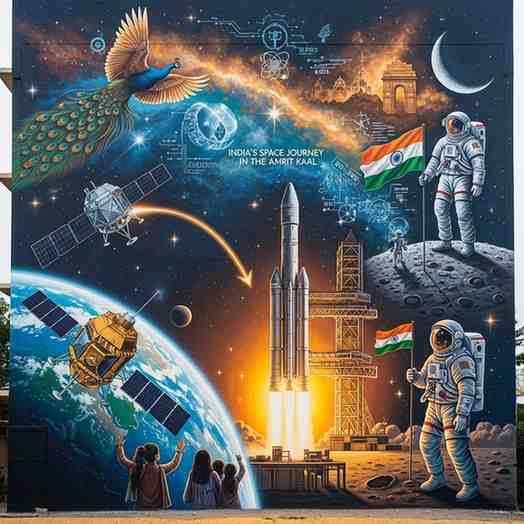
In the Amrit Kaal, India’s space programme tells a story larger than science. It is a narrative of confidence built through competence, ambition grounded in policy and inclusion, and a nation learning to imagine itself at planetary scale. The stars, once symbols of distant aspiration, have become markers of collective possibility—signalling that India’s rise is not only measured on Earth, but also among the heavens.
Month: Current Affairs - January 03, 2026
Category: