Overview
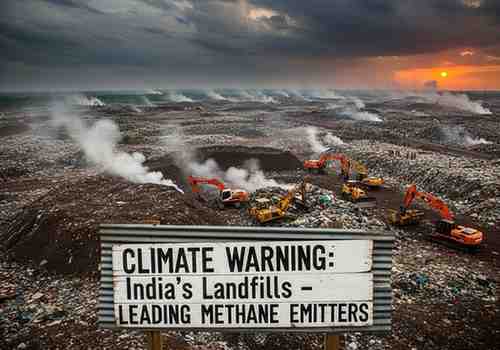
Two Indian landfills have been declared as one of the 25 methane super-polluters in the world in 2025: one in Telangana and one in Maharashtra. The report on the findings was conducted by UCLA STOP Methane Project, which outlines the environmental dangers of waste management and fast urbanisation.
Key Highlight: Colombia’s Anti-Fracking Movement
The satellite data (Carbon Mapper) indicated in the report monitored:
- The presence of almost 3,000 methane plumes in 700+ landfills in the world.
- Between 3.6 to 7.5 tonnes per hour.
- The highest emissions (~7.6 tonnes/hour) were measured at a landfill adjacent to Buenos Aires.
These results highlight the magnitude and the presence of methane emissions in waste sites.
The importance of Methane Emissions.
Methane is a very strong greenhouse gas that is much more potent than CO 2 in the short run.
- A landfill with 5 tonnes/hour emission corresponds to almost 1 million SUVs.
- Adds to global warming and ozone layer formation.
- Affects the air quality and health of the population in the city.
The anaerobic decomposition of organic waste in landfills emits methane, which is a significant problem in climate change management.
Waste Sector and Mitigation Scope of India.
The United Nations Environment Programme says that approximately 20 per cent of the world-wide methane emissions are created in the waste sector. India has a high mitigation potential in:
- Organic waste segregation
- Landfill gas collection systems.
- Waste-to-energy technologies
They are affordable measures that are climate and economically friendly.
International and Policy Implications.
The report will enhance transparency and hold governments further into quicker landfill reforms. Brazil, Chile, Turkey, and India have numerous sites of high emission. There are initial reactions in certain areas that data-driven surveillance can lead to remedial intervention.
Exam-Focused Key Points
- Two Indian landfills among the leading methane emitters.
- In the short-term, methane is a stronger warming agent than CO 2.
- Waste industry produces approximately 20 percent of the world methane.
- Carbon Mapper is an application that monitors emissions with the use of satellites.
- Mitigation consists of segregation and gas capture.
MCQ
Q1. Landfill emissions of Methane are mostly due to:
A. Incineration of plastic wastes.
B. Aerobic waste decomposition.
C. Anaerobic breakdown of organic matter.
D. Industrial chemical reactions.
Answer: C
Explanation: Methane
Month: Current Affairs - April 22, 2026
Category: Environment | Climate Change