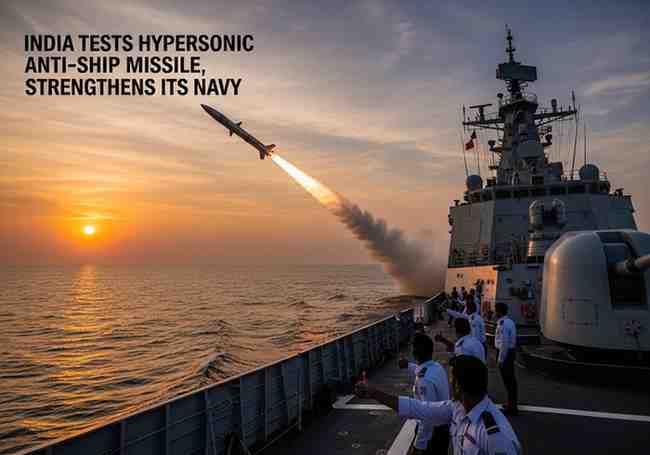
missile.
Test Significance and Strategic Impact
The second test, which was successful, proves:
- Reliability of the system
- Accuracy of targeting
- Stability of hypersonic glide technology
It also demonstrates that India is taking a step forward in sophisticated defence systems.
Indigenous Development role.
The development of the missile was done under the Dr APJ Abdul Kalam Missile Complex in Hyderabad.
It involved:
- DRDO laboratories
- Indian industry partners
This is the Indian emphasis on self-sufficiency in defence technologies .
The Emerging Hypersonic Capability in India.
One of the main components of contemporary war is hypersonic weapons. This technology is only available in a number of countries.
India’s progress shows:
- Well-developed research and development.
- Advanced engineering capability
- Strategic preparedness
This puts India in one of the top countries in defence innovation.
Further Insight: Reasons Why Hypersonic Weapons are Game-Changers.
The nature of war is altered by the use of hypersonic missiles.
Advantages:
- Extremely fast response time
- Hard to intercept
- High precision
They slow down reaction time of enemies and raise the rate of missions success.
Difficulties and Future Perspectives.
Nevertheless, there are still issues:
- High cost of development
- Complex testing requirements
- Need for advanced tracking systems
India will go on with the development of these systems towards higher performance.
Conclusion
A key success is the successful test of LR-AShM. It enhances the maritime defence and technology capacity of India.
It also demonstrates the Indian desire to develop advanced and indigenous defence systems in the future security requirements.
Exam-Focused Points
- LR-AShM = Long-range Anti-Ship Missile.
- Developed by DRDO.
- Speed: To Mach 10.
- Range: 1,500+ km.
- Relying on the technology of hypersonic glide vehicle
Month: Current Affairs - May 03, 2026
Category: Defence Technology - Missile Systems