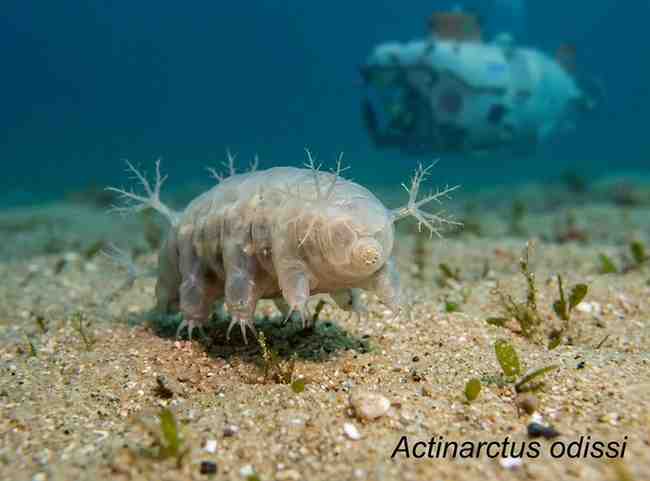
0.05 mm to 1.2 mm. They are plump, bilaterally symmetrical, and segmented. They have four pairs of legs. Each leg ends in four to eight tiny claws.
What do they eat? Tardigrades feed on the fluids of plant cells, animal cells, and bacteria. They use a sharp mouthpart to pierce cells and suck out the liquid.
The Amazing Survival Abilities of Tardigrades
Tardigrades are famous for one thing: they can survive extreme conditions that would kill almost any other animal.
-
Heat and cold : They can survive punishing heat and freezing cold.
-
Radiation : They can withstand ultraviolet radiation that is deadly to humans.
-
Outer space : Tardigrades have been sent to space and survived the vacuum and cosmic rays.
How do they do it? When conditions become unfavourable (like a drought or extreme cold), tardigrades go into a state called the “tun” state . In this state, their body dries out and becomes a lifeless-looking ball. Their metabolism slows down to as little as 0.01% of its normal rate. They can stay in this tun state for years or even decades. When water and good conditions return, they rehydrate and come back to life. This makes them one of the toughest creatures on the planet.
A Human Touch: Why a Tiny Creature Matters
A scientist in a lab in Odisha peers through a microscope. She sees a tiny dome-shaped animal with wing-like flaps. It is smaller than a grain of sand. She realises it is a tardigrade she has never seen before. She checks all the records. No one has described this species. After months of study, she names it after her state’s beautiful dance form – Odissi. This is not just science. It is pride. It is connection. It shows that even the smallest creatures can carry the biggest stories.
Exam-Focused Points
| Topic |
Key Details |
| Species name |
Actinarctus odissi |
| Type of animal |
Tardigrade (marine water bear) |
| Location found |
Shallow marine waters of Bay of Bengal, near Markandi, Odisha |
| Named after |
Odissi classical dance form of Odisha |
| Significance |
First new species of this genus in 43 years |
| Body shape |
Dome-shaped |
| Unique feature |
Transparent wing-like flaps (alae) with translucent pillars |
| Shorter lateral
Month: Current Affairs - May 25, 2026
Category: Environment, Biodiversity
|