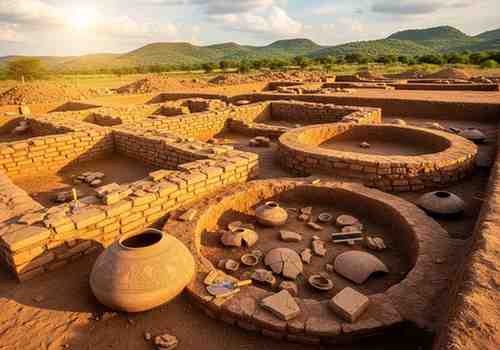
Hindu statues also show that later periods saw a blending of faiths.
Historians, scientists, and conservationists are now calling for intervention by the Archaeological Survey of India (ASI) . The ASI is the central agency for archaeological research and monument protection in India. They want the ASI to survey the area properly and declare it a protected site. Without protection, farmers and builders may accidentally destroy valuable remains.
A Human Touch: A Farmer’s Accidental Discovery
Imagine a farmer named Sukhram in Mangarh village. One morning, he is digging a pit for a new well. His shovel hits something hard. He pulls out a dark, shiny piece of pottery. He sees a stone face with closed eyes – it looks like a Buddha. He does not know its age. He only knows it feels old and special. He keeps it in his cowshed. Later, scientists visit his village. They see the artefact and get very excited. Sukhram learns that his field sits on top of a 3,000-year-old town. He feels proud. His small village is now part of India’s grand history. That is the human story behind every archaeological find.
Exam-Focused Points
| Topic |
Key Details |
| Location |
Hazaribag district, Jharkhand; Mohane river basin, Chauparan block |
| Villages involved |
Dehar, Sohra, Mangarh, Hathinder |
| Age of settlement |
Nearly 3,200 years |
| Survey teams |
IIT-ISM Dhanbad and Visva-Bharati University |
| Technology used |
Ground Penetrating Radar (GPR) |
| GPR purpose |
Detect buried structures without excavation |
| Buried structures found |
Over 100 feet in length |
| Pottery found |
Northern Black Polished Ware (black-glazed, early historic period) |
| Statues found |
Gautam Buddha, Tara, Marichi, Avalokiteshvara, Brahma, Vishnu, Mahesh, Ganesha |
| Ancient stupa location |
Large mound in Mangarh village |
| Stupa age |
About 2,500–3,000 years old |
| Need for protection |
Archaeological Survey of India (ASI) intervention |
| What is a stupa |
Buddhist funerary and commemorative structure |
| What is Northern Black
Month: Current Affairs - May 25, 2026
Category: History, Geography
|